Fixed Price vs Time and Materials: Which Software Contract Is Better?





When you decide to work with the best software development company, you have to select the best engagement model to deliver your digital product. A quote can look reassuring until the project changes. A customer asks for a new workflow. An old system behaves differently than expected. Suddenly, the agreement matters as much as the code.
Mostly, there are two mainstream software development engagement models:
· Fixed price
· Time and materials
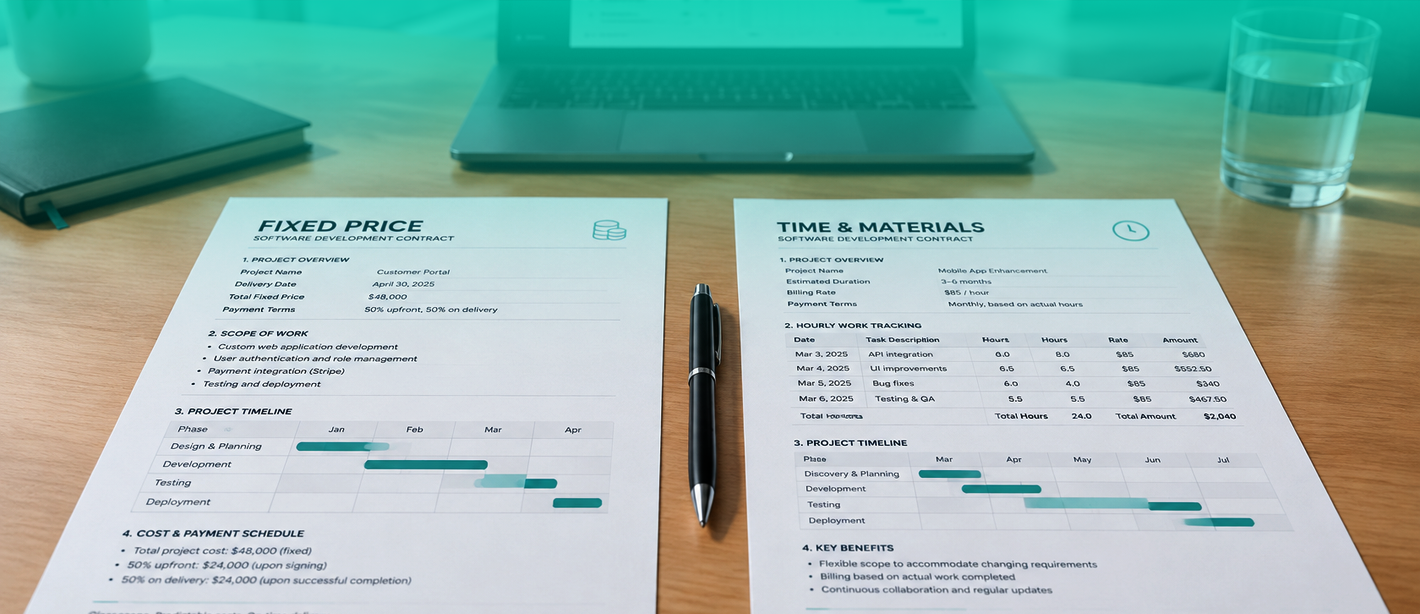
Choosing between two models is similar to a coin toss. Fixed price works best for clearly defined work with stable requirements. Time and materials work best when needs may change and you can actively manage priorities and spending. Neither model guarantees lower costs or better software. In this article, you will get a clear difference between both models, their pros and cons, and how to project your budget with either one.
Quick answer: A fixed price contract is better when your scope is clear, stable and short. A time and materials contract is better when requirements will change or the product will keep growing. For most custom builds, a hybrid works best: start with a short paid discovery phase, then pick the model that fits what you learned.
Time and Materials vs Fixed Price Comparison
These software development pricing models set different rules for payment and change. Start with this comparison before reviewing a vendor’s proposal.
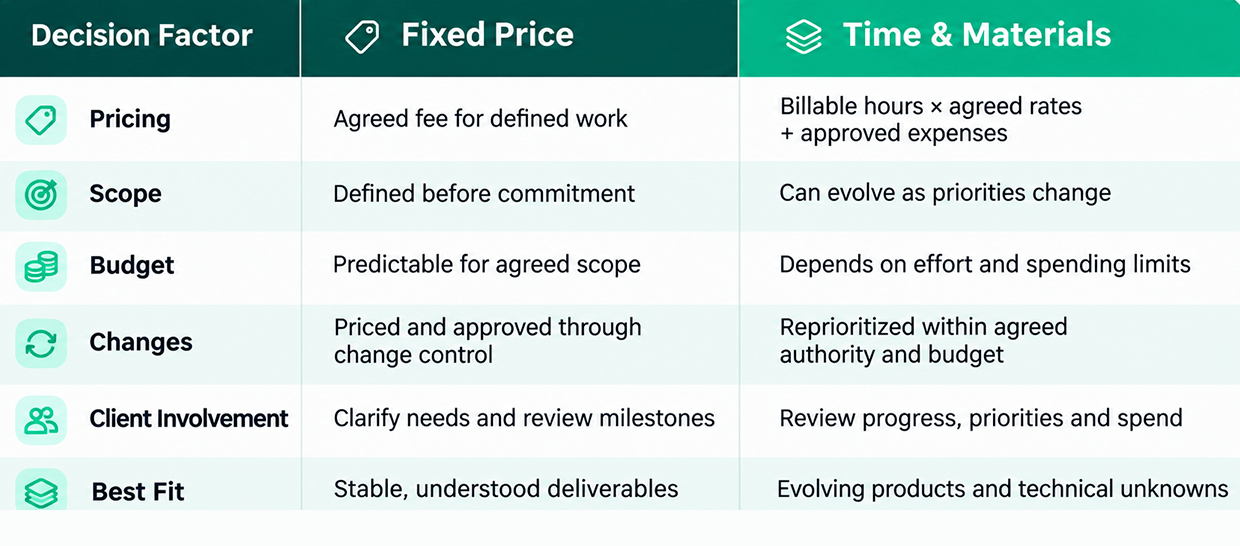
The signed agreement defines duties. A pricing label alone cannot tell you what is included, who approves changes, or how unfinished work is handled.
What is Fixed Price Software Development
Fixed price software development is a contract model in which both client and developer set an agreed amount for defined output. The development team estimates the work before committing, and both parties define the scope, timeline, features, and total price.
Here is how fixed price software development usually works:
- Requirements: You and the vendor write a detailed spec. A clear product requirements document is essential here.
- Quote: The vendor estimates the effort and adds a risk buffer.
- Milestones: The work is split into milestones, each tied to a payment.
- Build and test: The team builds against the spec.
- Acceptance: You check each milestone against agreed criteria, then pay.
The catch is that buffer. Because the vendor takes on the risk, they charge for it. You pay for certainty, even if nothing goes wrong.
There's a quieter risk too. Fixed pricing depends on the quality of that early planning. Missing requirements can lead to disputes, extra charges, or delays while changes are agreed. Vendors may also include contingency in their prices to cover uncertainty. That is a business trade-off, not proof that a quote is unfair. That's why quality assurance and clear acceptance criteria matter so much in a fixed price deal.
What are the Key Components of a Fixed Price Software Development Project
Scope and Requirements
It is an initial point when you need 100% of the requirements before providing any pricing structure. It includes all the acceptance criteria, APIs, timelines, wireframes, and scope.
Timeline and Milestones
Plan the complete roadmap: discovery, design, development, testing, and launch. The developer divides the work into milestones; for example, the design process will be complete in 6- 8 weeks. This planning provides early visibility, supports quality validation, and helps identify problems.
Pricing Structure
Pricing structure depends entirely on the project's complexity, features, and UX needs. Vendors get reviews from experts who have performed similar tasks.
Contractual Terms
The terms describe the timeline, milestones, exact scope, acceptance criteria, and the complete process. Every change affects the cost and the estimated timeline. Consider both penalties and incentives at the same time.
When the Fixed Pricing Model Works Best
Fixed price software development is the best option when your project is:
· Small to be completed in 8-12 weeks, with limited scope
· Have to add specific features in an already developed product
· The MVP has clear requirements
· Project that doesn’t require the work of UX
· Rebuilding an already existing system or migrating it to a new tech stack
What is a Time and Materials Contract?
A time and materials contract offers a flexible pricing model that charges based on agreed hours or daily hourly rates. The amount depends on the hours spent on the project. There's no fixed total. Instead, you control the scope and the budget as you go.
A typical time and materials project runs like this:
- Short discovery: The team learns your goals and builds a first backlog.
- Sprints: Work happens in one- or two-week cycles.
- Demos: You see working software at the end of each sprint.
- Reprioritize: You decide what to build next based on what you learned.
- Invoices: You're billed monthly, with timesheets to show where hours went.
This model fits naturally with agile product development. You can change direction after user feedback without renegotiating a contract. This suits products where the goal is clear but the best route remains uncertain. For example, a team exploring a new onboarding flow may need several rounds of testing.
Flexibility does not make spending predictable. A growing backlog, slow decisions, and repeated rework can increase costs even when every invoice is accurate. You need a person who can approve priorities, review progress, and challenge work that adds little value. Timesheets show effort; demos and agreed checks show what that effort produced.
When T&M Works Best
Choose the time and material software development pricing model when your project is:
· Fresh idea with uncertain scope
· Startup that wants to build product from scratch
· Machine learning, AI, generative models, or any other components
· Critical third-party integration, such as syncing data between your app and CRM
· Changes more than 30%
· When roadmap exceeds 12 months with continuous releases
Time and Materials vs Fixed Price: What the Research Says
The debate about time and materials vs fixed price really comes down to one question: how likely is your plan to change? The data says "very likely."
- Scope changes are the norm. PMI's 2018 Pulse of the Profession survey found that 52% of projects experienced scope creep, up from 43% five years earlier.
- Big IT projects overrun badly. A McKinsey and University of Oxford study of more than 5,400 IT projects found that large IT projects run 45% over budget and 7% over time, while delivering 56% less value than predicted. Every extra year of schedule added about 15% to cost overruns.
- Iterative work succeeds more often. The Standish Group's 2015 CHAOS report found that agile projects succeeded 39% of the time, compared with 11% for waterfall projects.
What does this mean for you? Locking in scope on a long or uncertain project rarely removes risk. It just moves the risk into change requests, delays and disputes. Fixed price works best when the project is small enough that the scope truly won't move.
Which Software Contract Costs More?
Neither model is automatically cheaper. Compare the same scope and quality expectations, then examine what happens when the plan changes. Consider a hypothetical customer portal. A vendor offers a $48,000 fixed fee. Alternatively, it estimates 600 hours at $70 per hour under T&M, or $42,000.
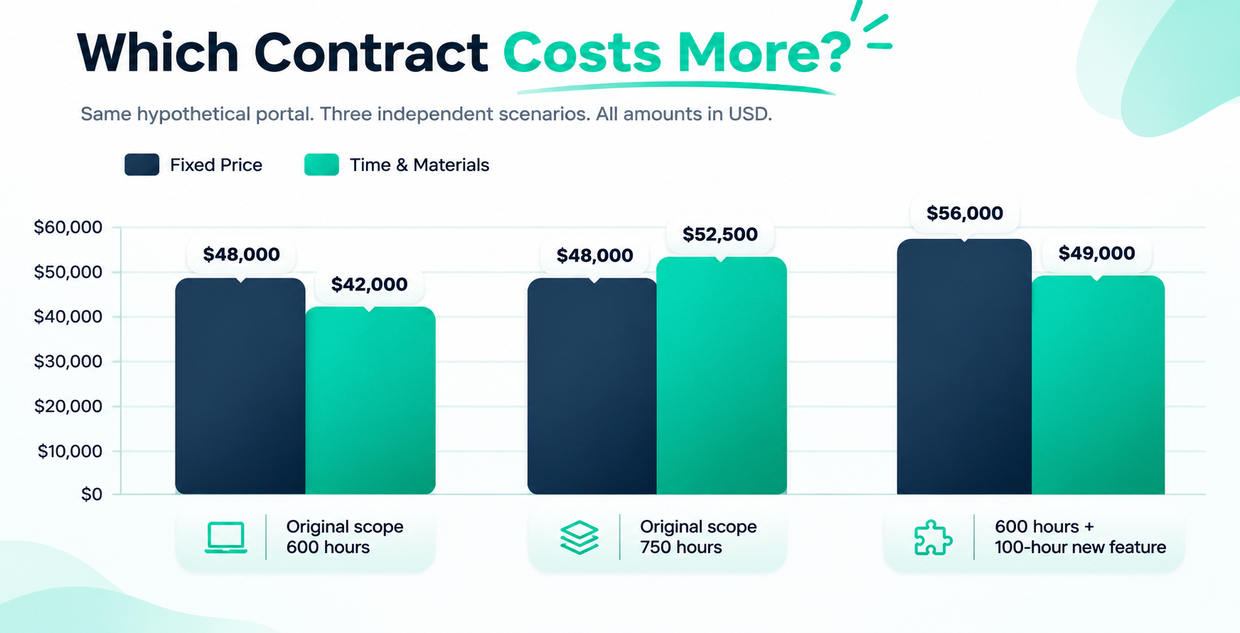
These are illustrative figures, not market rates or an Amrood Labs quote. The second row assumes the vendor bears the extra effort for unchanged, included work. The third assumes an approved $8,000 fixed-price change order, versus 100 additional T&M hours at $70. Each row is a separate scenario.
The initial T&M estimate is lower, but it is not a price guarantee. The fixed fee buys more certainty for the defined work, while approved changes can still increase total spending. Before comparing proposals, check whether both include design, testing, project management, deployment, and support. A cheaper quote may simply cover less work.
The Hybrid Pricing Model: Often the Smartest Choice
You don't have to pick one model for the whole project. A hybrid pricing model in software development lets you use each contract where it fits best. Here are the most common setups:
Paid discovery, then decide. Run a short time and materials discovery phase of two to four weeks. You'll come out with a clear scope, a prototype and a solid estimate. Then fix the price on stable parts and keep the rest flexible.
Capped time and materials. You pay hourly, but the contract sets a not-to-exceed limit for each phase. You get flexibility with a safety net.
Fixed price per milestone. Break a large project into small, fixed-price chunks. Each one is easier to scope, so buffers stay smaller.
Dedicated team. For long-term work, a dedicated development team or staff augmentation gives you a steady monthly cost and full control of priorities.
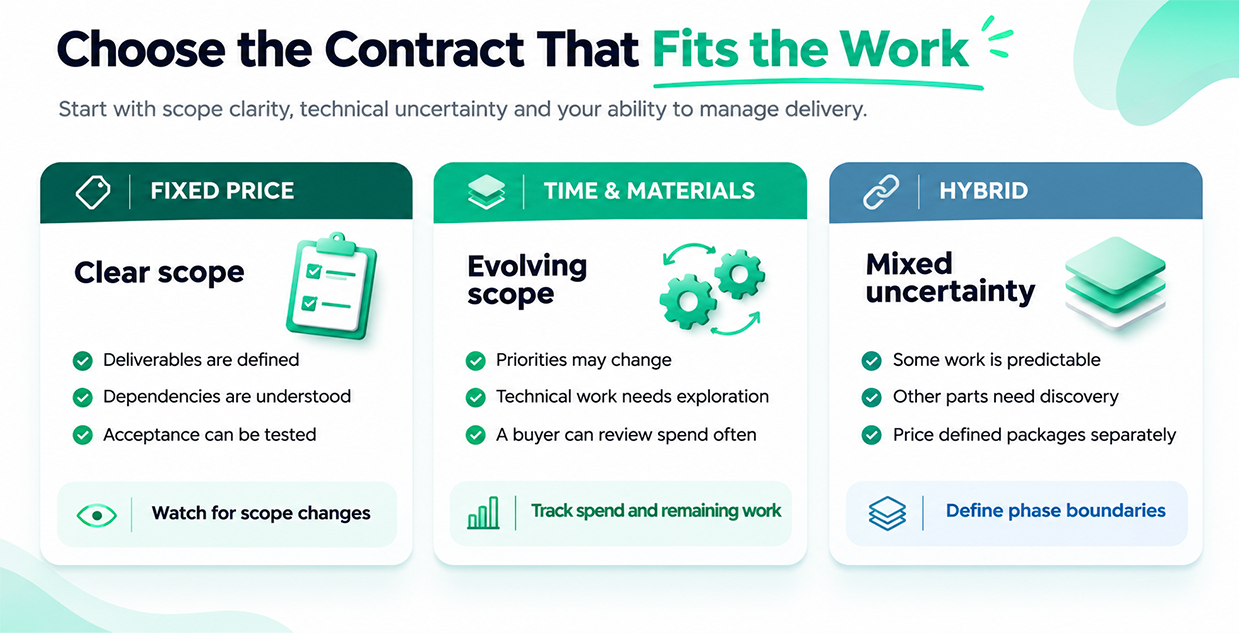
A common pattern looks like this: a fixed price for a well-defined MVP, then monthly time and materials for growth after launch.
When should you switch from flexible to fixed? When requirements have stayed stable for two or more sprints, acceptance criteria are signed off and estimates have stopped moving.
How to Control Budget and Quality Under Either Model
Good software development pricing models need clear working practices behind them. Agree these before the first invoice.
Define What “Done” Means
Replace vague requirements such as “fast dashboard” with testable expectations. Specify supported devices, access rules, key workflows, and performance targets where relevant.
Include testing and release responsibilities. Understanding the role of quality assurance in software development helps keep quality work visible in estimates and delivery plans.
Review Spending Against Remaining Work
For T&M, ask for actual spending, completed deliverables, and an updated forecast to finish the current scope. An invoice alone cannot show whether the remaining budget is enough.
For fixed pricing, review milestone progress and proposed changes. Ask about delivery risks before they become missed dates.
Set Clear Approval Rules
Agree who can authorize new features, rate changes, extra staff, and third-party expenses. Record the likely impact on cost and timing before work begins.
Also distinguish defects from enhancements. Fixing behavior that fails agreed acceptance criteria is different from adding a new workflow, although payment responsibilities depend on the contract.
Compare The Team Behind The Price
Ask who will actually do the work and how the vendor handles absences, specialist input, and changes in staffing. A low hourly rate offers little comfort if the team needs twice as long to solve the problem.
Request a sample progress report and a walk-through of a relevant project. Look for clear explanations of decisions, trade-offs, and testing. You are assessing how the vendor works when something goes wrong, as well as what it promises when everything looks straightforward at the start.
Agree these details before signing anything.
Plan The Handover
Confirm access to source code, documentation, deployment instructions, and relevant accounts. Clarify support periods and exit arrangements.
A project should leave your business able to operate and maintain the product, rather than dependent on undocumented knowledge.
Quick Checklist: Which Software Contract Should You Pick?
Answer these five questions honestly:
- Can you describe every feature in writing today?
- Will the scope stay the same for the whole project?
- Is the project shorter than three months?
- Do you need a single, fixed number for budget approval?
- Would you rather review results at the end than steer each week?
Mostly yes: a fixed price contract is a safe pick.
Mostly no: go with time and materials.
A mix: start with paid discovery and use a hybrid.
Contract Clauses to Check Before You Sign
Whichever of these software development pricing models you choose, check that your contract covers:
- Change requests: how changes are estimated, approved and priced
- Acceptance criteria: what "done" means for each deliverable
- Payment schedule: milestone payments or monthly billing
- IP ownership: you should own the source code once you've paid
- Termination: notice period, handover and documentation
- Warranty: how long the vendor fixes bugs for free after launch
- Reporting: timesheets, burn rate and demo cadence (essential for time and materials)
Always have a lawyer review the final agreement.
Final Thoughts
There's no single winner in the fixed price vs time and materials debate. The better contract is the one that matches how much uncertainty your project carries.
- Clear, small, stable scope? Fixed price.
- Evolving product or unclear requirements? Time and materials.
- Somewhere in between? A hybrid, starting with paid discovery.
Not sure where your project fits? Book a free scoping call with our team. We'll review your idea and recommend the contract that protects your budget, even if it isn't the one that earns us the most. You can also browse our case studies to see how we've structured real projects.
FAQs
Is fixed price cheaper than time and materials?
Not by default. A fixed price contract includes a risk buffer, so it often costs more when nothing changes. Time and materials can be cheaper when scope is managed well. Fixed price wins only when scope is truly stable.
Which contract is best for an MVP?
Usually time and materials, or a hybrid. MVPs change quickly after real users try them. If your MVP scope is small and well defined, a fixed price quote can work. Many teams, including ours, quote MVPs at a fixed price after discovery.
Can I switch from fixed price to time and materials mid-project?
Yes, if both sides agree. It's common to finish a fixed price phase and then move to time and materials for the next release. Put the switching terms in the contract from the start.
What is a not-to-exceed clause?
It's a cap in a time and materials contract. You pay for actual hours, but never more than the agreed limit for that phase without your written approval.
Does fixed price work with agile development?
It can, if you fix the price per sprint or per milestone rather than for the whole project. Fixing the full scope up front works against agile's core idea of learning as you go.