AI Contextual Governance Solutions: A Practical Guide
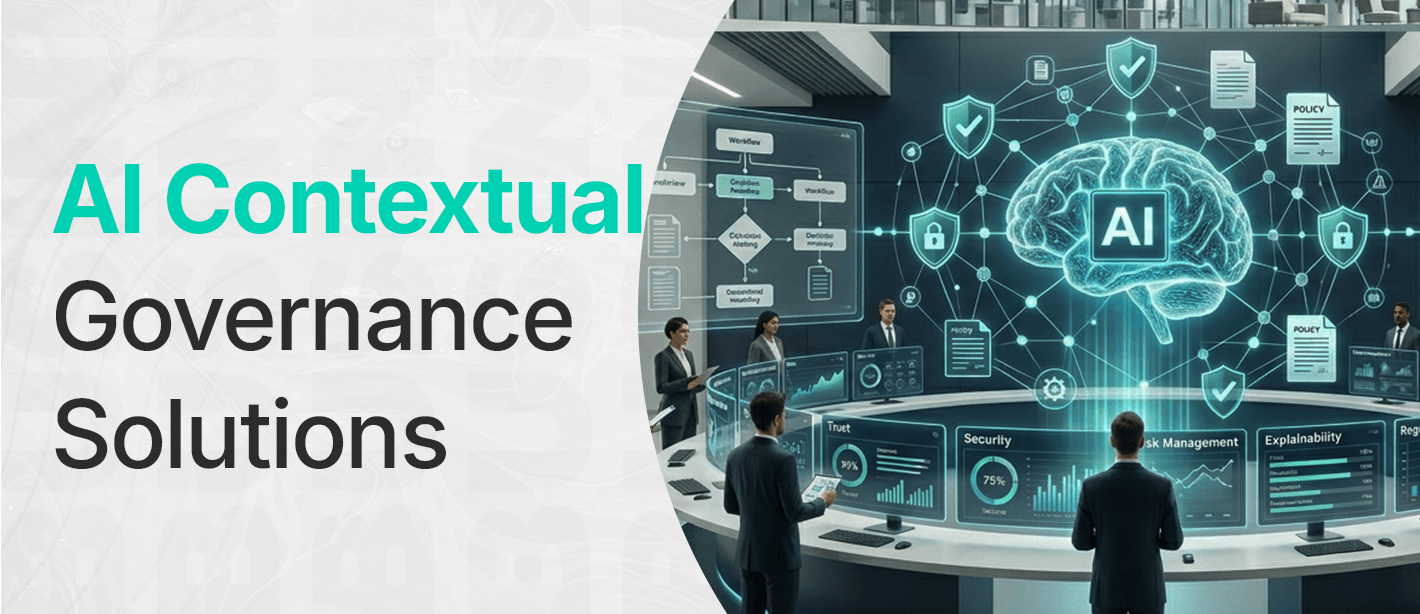

AI governance has moved from a policy discussion to a business requirement. The worldwide AI governance market was valued at $308 million in 2024-2025 and is expected to touch the $3.69 billion by 2032. Companies are no longer stuck asking whether to implement AI in the project. Rather, they ask how it should be used, how it is handled, what data it can touch, and how leadership can see whether it is creating risk or value.
That is where an AI contextual governance solution becomes important. Traditional governance often starts with a policy document. Contextual governance goes further. It connects AI rules to the actual business setting: the user, the tool, the data, the workflow, the department, and the level of risk.
For companies building AI systems, internal tools, or automation workflows, custom AI solutions can help make governance part of the product architecture instead of adding it later. This guide will explain all the essential categories of AI governance solutions.
What Is an AI Contextual Governance Solution?
An AI Contextual Governance Solution is a system of policies, controls, tools, reviews, and workflows that manages AI use according to business context. Instead of applying the same rule to every team and every AI tool, contextual governance adjusts requirements based on risk.
For example, a marketing team using AI to brainstorm blog ideas does not need the same level of control as a legal team using AI to review confidential contracts. A customer support chatbot handling personal data needs stricter oversight than an internal productivity assistant. A developer using AI to write code needs a security review, testing, and approval before the generated code moves into production.
This is where contextual governance becomes useful. It connects AI policy with real business use. Companies using AI automation services can apply these controls directly into workflows, approvals, and operational systems.
Why Context Matters in AI Governance
AI governance fails when it is too generic. A one-page policy saying “use AI responsibly” does not tell employees what data they can enter, which tools are approved, who owns the output, or when human review is required.
Context matters because AI risk changes by department, data type, and use case. HR teams may face bias and fairness risks. Finance teams may face reporting and compliance issues. Legal teams may handle confidential documents. Developers may introduce security flaws through AI-generated code. Customer support teams may expose sensitive user information if AI tools are not controlled.
A strong governance model should consider:
- User role
- Department
- Data sensitivity
- AI tool type
- Business purpose
- Output impact
- Regulatory exposure
- Required human review
Companies can also learn from broader privacy and analytics trends. This article on AI-driven data privacy and compliance risks explains why data governance, auditability, and privacy controls are becoming more important as AI adoption grows.
How AI Governance Solutions are Different from AI Governance Frameworks
The main role of AI Governance is to explain the rules, such as who is accountable, what tools need to be used, and what type of information can be shared with AI. On the other hand, an AI governance solution enforces it.
The NIST AI Risk Management Framework, the EU AI Act, and ISO/IEC 42001 are all tools that establish the governance baseline for responsible AI.
Governance solutions are the operational layer that assist business implement the requirements. Both are essential. An effective and reliable AI governance requires both a framework to explain the essential rules and a technical solution to measure the results.
What Issues Do AI Contextual Governance Solutions Solve?
It is not compulsory that every AI governance product solves the same problem. Some tools help with policy documentation, some focus on model risk. While some track AI usage. Others support access control, audit logs, or compliance reporting.
The right AI governance solutions depend on where the company’s risk lives.
1. AI Policy and Compliance Management
Policy tools help companies document internal AI rules, define approved use cases, assign owners, and prepare for audits. They are useful for legal, compliance, and leadership teams.
They usually answer questions like:
- Which AI tools are approved?
- Who owns AI governance?
- What rules apply to each department?
- Which regulations affect the company?
- What evidence is needed for audits?
These tools support AI compliance, but they do not always enforce behavior inside daily workflows. A policy can say employees should not paste customer data into public AI tools, but the policy alone may not stop them. That is why companies also need technical controls, training, and monitoring.
2. AI Use Case Inventory
Before a company can govern AI, it needs to know where AI is being used.
An AI use case inventory tracks:
- Tool name
- Department
- Business purpose
- Data type
- Owner
- Risk level
- Approval status
- Review requirements
- Logging needs
This inventory gives leaders a full view of AI adoption across the organization. Without it, AI usage becomes scattered. Different teams may buy tools, test models, or use public platforms without any shared record.
For companies creating internal systems, software development for business systems can support dashboards, role access, workflow records, and approval tracking.
3. Risk Classification
A useful governance program separates AI use cases by risk level. Low-risk AI may include internal brainstorming, public content summaries, or basic productivity tasks. Medium-risk AI may include customer-facing assistance, internal analytics, or business process automation. High-risk AI may include legal review, hiring support, financial recommendations, healthcare workflows, or decisions that affect people’s rights or money.
An AI contextual governance solution, medium risk category, is helpful because many business AI use cases are not harmless, but they are also not high-risk decision systems. They need controls such as approved tools, audit logs, human review, and data limits.
This kind of classification helps companies avoid two common mistakes: over-controlling simple tasks and under-controlling sensitive workflows.
4. Data Governance and Access Control
AI governance depends heavily on data governance. If a company cannot classify its data, it cannot decide what AI tools should be allowed to process it.
Data can be grouped into different categories such as:
- Public data
- Internal documents
- Customer data
- Financial records
- Legal documents
- Source code
- Personal information
- Regulated data
Each category needs different rules. Public data may be safe for some approved AI tools. Customer data may require masking. Legal documents may require secure storage. Source code may need extra review before it is used or shipped.
5. Monitoring and Audit Trails
A governance program needs proof. It should show who used AI, what tool was used, what type of data was involved, what output was created, and whether the correct review process happened.
Audit trails are especially important for regulated industries, legal teams, finance teams, and customer-facing systems. They also support AI governance oversight because leaders can see how AI is being used across the company.
This is where operational dashboards, logging, and workflow tracking become valuable. For example, AI-assisted workflows with audit logs show how automation and tracking can improve operational control.
Top 6 AI Governance Solutions IT Experts Are Evaluating in 2026
Below are six AI governance solutions companies are reviewing in 2026. Each one solves a different part of the problem, so many organizations may use more than one approach.
1. Blue Border™ by Venn: Endpoint AI Governance for Personal and Contractor Devices
Best for: Companies with contractors or remote employees, or BYOD teams working from personal laptops.
Many AI governance platforms specifically focus on internal AI models, managed devices, and other AI models. Blue Border™ uses a different approach by securing the endpoint on devices the company does not own. It helps in creating a company-controlled work area on a PC or Mac, and separate business applications from personal information.
This has an importance because many employees may use tools like ChatGPT, Claude, local LLMs, or OS-level AI assistants on the personal side of the device. With Blue Border™, those tools cannot access company data inside the protected work area unless IT allows them.
For businesses building AI-enabled systems, endpoint control should also be supported by strong AI solutions, secure architecture, and clear data policies. If your product uses AI across web, mobile, or cloud workflows, working with an experienced product development company can help you reduce data exposure from the start.
2. Microsoft Purview: Data Classification and Compliance Across Microsoft Systems
Best for: Organizations that already rely on Microsoft tools across cloud, productivity, and enterprise systems.
Microsoft Purview helps companies classify data, manage compliance, apply DLP rules, and monitor the process of data movement across the Microsoft environments. It is beneficial for the developer team using Azure, Microsoft 365, and Microsoft AI services.
The biggest strength is its ecosystem coverage. If your data and any personal information are already present in the Microsoft infrastructure, Purview can give IT and compliance teams stronger visibility and audit control. The only drawback is that coverage becomes weaker when employees use non-Microsoft apps, unmanaged devices, or external AI tools outside the Microsoft environment.
3. IBM watsonx Governance: Model Risk and Responsible AI Management
Best for: Enterprises building, training, or deploying their own AI models.
IBM watsonx Governance focuses on the AI model lifecycle. It helps teams monitor model risk, explainability, bias, performance, and compliance evidence. This is the best fit for the businesses that build internal AI products or fine-tune models.
However, watsonx is not mainly designed to control which third-party AI tools employees use at work. If the main concern is that staff don’t copy data into AI tools, you still require endpoint, DLP controls, and SaaS.
For teams building internal AI platforms, strong backend engineering is just as important as governance. Businesses can support these systems with skilled Python teams by choosing to Django developers or Flask developers for secure APIs, data pipelines, dashboards, and AI-powered web platforms.
4. Credo AI: AI Risk Assessment and Policy Automation
Best for: Companies building formal AI governance programs and repeatable compliance workflows.
Credo AI helps governance, risk, and compliance teams assess AI systems against internal policies, regulations, and responsible AI standards. It supports risk reviews, documentation, and policy checks so teams can turn AI principles into repeatable processes.
This is valuable for companies that want more than one-time AI reviews. Instead of manually checking every AI use case, teams can build a process for approvals, tracking, and evidence collection.
If your company is building AI-powered customer tools, SaaS products, or internal automation platforms, governance should be included early in the product roadmap.
5. Enterprise Browsers: Browser-Based AI Governance for Web AI Tools
Best for: Organizations where most AI tool usage happens inside browsers.
Enterprise browsers such as Island and Talon help companies control browser activity. They can block certain AI websites, apply data protection rules, manage copy-paste behavior, and give IT teams visibility into web-based AI use.
This works well when most employees use AI through browser tools. But browser-level control has a clear gap: it does not govern desktop AI apps, local models, or OS-integrated AI assistants. For example, if an employee uses a locally installed AI tool outside the browser, an enterprise browser may not see or control that activity.
Teams building browser-heavy products should also make sure their apps are fast, secure, and easy to maintain. For frontend-heavy builds, companies can hire Next.js developers, while backend-heavy platforms may benefit from teams that hire Node.js developers.
6. SaaS Discovery and Shadow AI Detection Tools
Best for: Organizations trying to understand which unsanctioned AI tools employees already use.
Shadow AI detection tools such as Zylo and Netskope help companies find unauthorized AI apps across SaaS usage, traffic patterns, and API activity. This gives IT leaders a clearer view of where AI tools are being used and what risks may exist.
These tools are often the first step in an AI governance program. They help answer a basic but important question: “What is actually happening across the company?” The limitation is that detection alone does not stop risky behavior. Once a company finds shadow AI usage, it still needs controls, policies, training, and technical enforcement.
Features to Look for in AI Governance Tools
AI Governance tools should do more than store policy documents. They should support active control, monitoring, and reporting.
Useful features include:
- Approved AI tool registry
- User and role permissions
- Data classification rules
- Prompt and output logging
- Risk scoring
- Approval workflows
- Human review triggers
- Alerts for risky behavior
- Vendor review tracking
- Compliance reports
A good Ai governance platform should give leaders practical visibility into usage, risk, and business value. Companies building AI products can review this AI-powered platform development case study for an example of scalable AI platform work.
Technical controls also matter. Governance should connect with secure infrastructure, cloud systems, and deployment workflows. Cloud services for secure AI systems can support hosting, monitoring, infrastructure management, and scalable deployment.
How to Build an AI Contextual Governance Framework
Building governance does not need to begin with complex systems. It should begin with clarity.
Step 1: Identify Current AI Usage
Start by listing where AI is already being used. Check teams, tools, SaaS platforms, browser activity, vendor products, support workflows, development tools, and marketing platforms.
Step 2: Map AI Use to Risk
Each AI use case should be mapped to risk. Ask whether the tool uses sensitive data, affects customers, creates legal exposure, touches regulated workflows, or produces outputs that influence business decisions.
Step 3: Define Context-Based Rules
For an AI contextual governance solution, policies should explain what is allowed, what is restricted, and what requires approval. These rules should be specific enough for employees to follow.
For example, marketing teams may use approved AI writing tools but cannot enter customer data. Developers may use AI coding assistants, but code must pass security review. Legal teams may use AI for document review only through approved tools with secure storage.
Step 4: Add Human Review
Human review is essential for high-risk use cases. AI output should not automatically become a final decision when legal, financial, health, employment, or customer impact is involved.
Step 5: Update the Program Regularly
Ai governance updates should happen on a set schedule. AI tools, laws, vendor terms, and business use cases change often. Governance should be reviewed as part of security, compliance, and leadership reporting.
How AI Governance Supports Strategic Visibility
An AI Contextual Governance Solution also supports AI governance strategic visibility. Leaders need to know where AI is being used, which teams are adopting it, which tools create risk, and which investments are producing value.
Without governance, AI activity becomes scattered. With governance, executives can see patterns, risks, adoption gaps, and opportunities. This is useful for budgeting, compliance, vendor management, product planning, and security oversight.
Ai governance oversight is not only about preventing problems. It is also about helping teams use AI with confidence and measurable business value.
Choosing the Right AI Governance Solution
The right AI Governance Solution depends on your company’s goals, risk profile, and technical environment.
Start with these questions:
- Do employees use public AI tools?
- Do you process customer or regulated data?
- Do you build internal AI systems?
- Do vendors handle your data?
- Do AI outputs affect customers or business decisions?
- Do you need audit evidence for compliance?
Companies building AI-enabled products should also think about governance during design and development. Product development services can help teams plan AI features, workflows, dashboards, approvals, and reporting layers from the start.
If you need technical support, teams may also require AI engineers, web developers, DevOps experts, and security-focused engineers. For example, companies can hire DevOps developers to support deployment, monitoring, CI/CD, and infrastructure.
Common Mistakes to Avoid
Many businesses make AI governance harder than it needs to be. The most common mistake is treating governance as a policy document only. A written policy is useful, but it needs enforcement, training, monitoring, and ownership.
Another mistake is ignoring shadow AI. If employees already use unapproved tools, the company needs visibility before it can manage risk.
Companies should also avoid applying the same rules to every AI use case. Low-risk writing support and high-risk financial recommendations should not follow the same approval process.
Vendor risk is another weak point. Before adopting any AI vendor, companies should review data storage, retention, model training policies, security practices, and contract terms.
Best Practices for AI Contextual Governance
A strong governance program should be simple enough for employees to follow and strong enough for risk teams to trust.
Best practices include:
- Create an approved AI tool list
- Classify data before allowing AI use
- Use role-based permissions
- Require review for high-risk outputs
- Track usage and decisions
- Train employees with real examples
- Review vendors before approval
- Keep audit logs
- Update policies as tools and laws change
Ai compliance should be part of daily work, not a separate checklist that teams only review once a year.
Conclusion
AI governance is becoming a core business need. Companies cannot rely on generic policies while employees use AI across departments, tools, devices, and workflows. Governance needs context.
The right AI contextual governance solution helps organizations manage AI based on user role, data sensitivity, business purpose, risk level, and compliance requirements. It gives teams practical rules, leaders better visibility, and organizations stronger control over AI adoption.
For businesses planning AI systems, automation, or governance-ready platforms, talk to Amrood Labs about AI development and build AI with the right controls from the start
Table of Content
Share Now
.png)