How AI Is Changing the Way Athletes Review and Sign Contracts


A rookie midfielder and a ten-year veteran used to face the same problem: a 40-page agreement, an attorney's hourly rate, and a deadline that didn't care which one they could afford. That gap is closing fast.
A few years ago, the only way an athlete could really understand a sponsorship clause buried on page eleven of a contract was to pay a lawyer by the hour and wait. That waiting period between signing something and actually understanding it is the part that's disappearing. AI sports contract analysis now does in minutes what used to take attorneys days: it scans every clause, flags risk, checks terms against league and federation rules, and hands the athlete a plain-language breakdown before they pick up a pen.
This isn't a future trend. It's already built into the tools agents, parents, and athletes are using today. Here's what's actually changed, who's building it, and what every athlete should ask before letting AI touch their next deal.
Why AI Sports Contract Analysis Is Replacing the Expensive Old Way
Sports contracts are deceptively dense documents. A single professional agreement can stack performance bonuses, image-rights clauses, release options, injury provisions, and federation-specific compliance language on top of each other, often in legal phrasing that even experienced agents have to read twice.
For athletes without a top-tier agency behind them, the usual fix was a slow one: hire outside counsel, wait days or weeks for a markup, and pay legal fees that could run into the thousands before a single signature was on paper. That cost structure quietly excluded exactly the athletes who needed protection most: youth players, free agents, and anyone outside a major market.
AI contract review for athletes changes that math. Instead of a generic legal assistant, purpose-built sports contract software reads a contract against a structured taxonomy of sport-specific clauses and returns a risk-ranked summary in minutes, not weeks turning legal review from a luxury into something closer to a basic utility.
Methodology: How a Contract Goes From Upload to Insight
The mechanics behind this are more structured than "AI reads your PDF." A modern review pipeline moves a contract through several distinct stages before an athlete ever sees a result, and understanding that pipeline is part of what makes this corner of sports law technology trustworthy rather than a black box.

That background processing matters more than it sounds. Contract analysis is computationally heavy, so the better platforms run it as a queued job rather than freezing the screen while an athlete waits for the same kind of AI workflow automation uses for leads generation.
How Sportiv.ai Took This From Idea to Product
Sportiv.ai started with a simple observation: athletes, agents, coaches, and even parents of youth players were stuck waiting on attorneys' availability for something that should take minutes, not weeks. The team behind it set out to replace that bottleneck with an AI-based review system that any sports professional, not just the ones with a legal department on speed dial, could use directly.
The platform was engineered around a structured athlete contract management workflow: upload a contract, run it through an AI engine trained on a 42-clause sports law taxonomy, and surface risks by severity rather than dumping a wall of flags on the user. To make the experience usable under load, contract analysis runs as background worker jobs rather than blocking the screen, with automatic retries if a document fails to process the first time.
- 42-clause taxonomy covering FIFA, FIBA, IHF, FIVB, and World Rugby contracts
- Secure contract library with full analysis history and PDF export
- Credit-based billing via Stripe, so users pay only for what they review
- Multi-language support, including English and Romanian
- Review time cut from days or weeks down to minutes
It's one of the clearer examples of AI legal review tools being purpose-built for sport rather than retrofitted from generic legal software. Read the full breakdown in our case study on building Sportiv.ai's contract intelligence engine.
The Tools Agents and Athletes Are Actually Using
The tools fall into two main categories. General-purpose legal AI, the same category powering corporate contract desks, has matured fast: Ironclad and SpotDraft now redline and risk-score contracts inside minutes, Luminance applies large-language-model review at law-firm scale, and Harvey has become the go-to genAI platform for BigLaw-grade analysis.
None of these were built specifically for sport, but agents increasingly run general agreements through them as a first pass. Sitting alongside that category are sport-native platforms, such as Sportiv.ai, among them, that swap a generic legal playbook for federation-specific clause libraries.
That distinction is the whole story of where AI sports contract analysis is headed: general legal AI for speed, sport-specific AI for context that a generic model simply doesn't have.
Smart Clauses: Contracts That Score Themselves
Performance-linked clauses, bonuses tied to appearances, minutes played, goals, or availability, used to be a manual accounting headache, tracked in spreadsheets long after the season that triggered them. AI changes the order of operations: instead of waiting for a dispute to surface a missed bonus, the system runs continuous contract risk assessment against live performance data, flagging triggered clauses as they happen rather than months later.
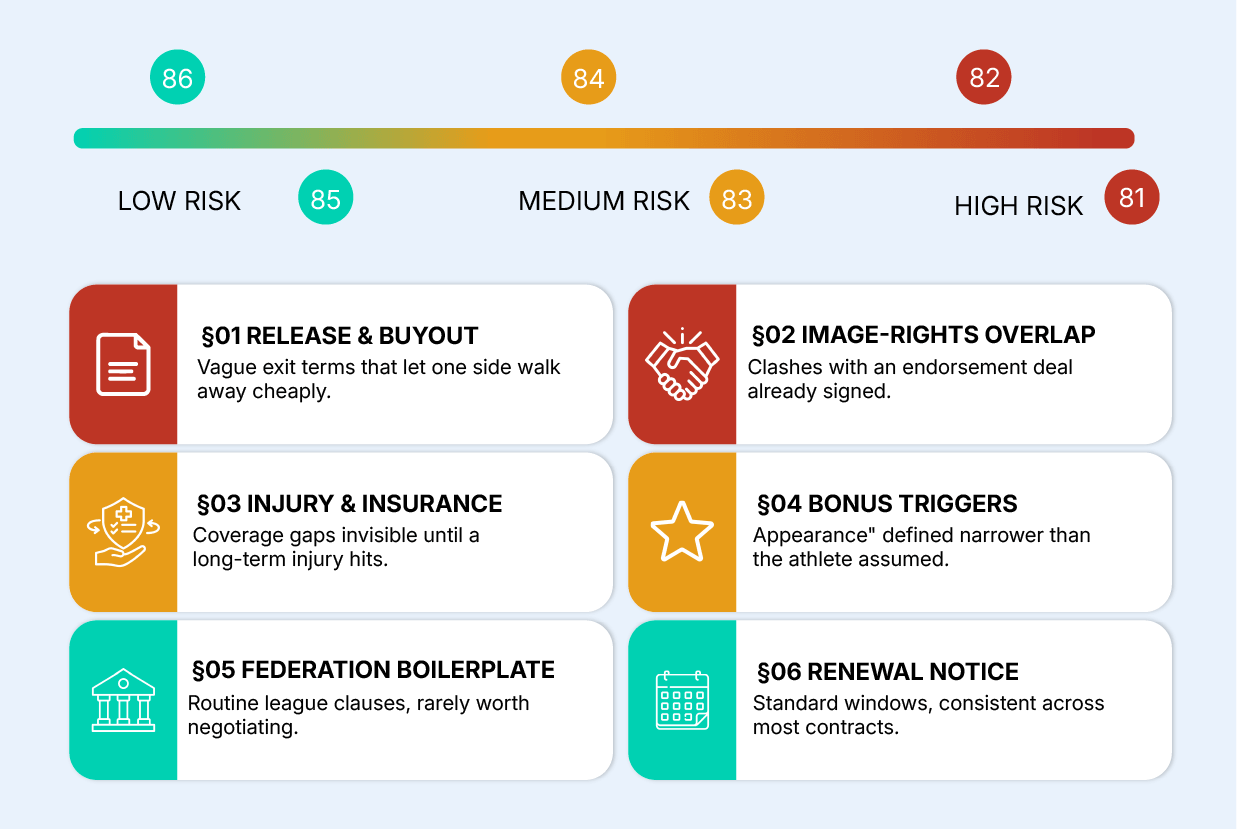
It's the same logic legal-tech researchers have already documented in basketball, where teams use predictive models to structure availability guarantees and incentive tiers around a player's actual usage pattern rather than a flat number. The clauses below are the ones AI tools flag most often, and the ones athletes most often sign without reading closely.
The NIL: Most Tools Still Aren't Built For
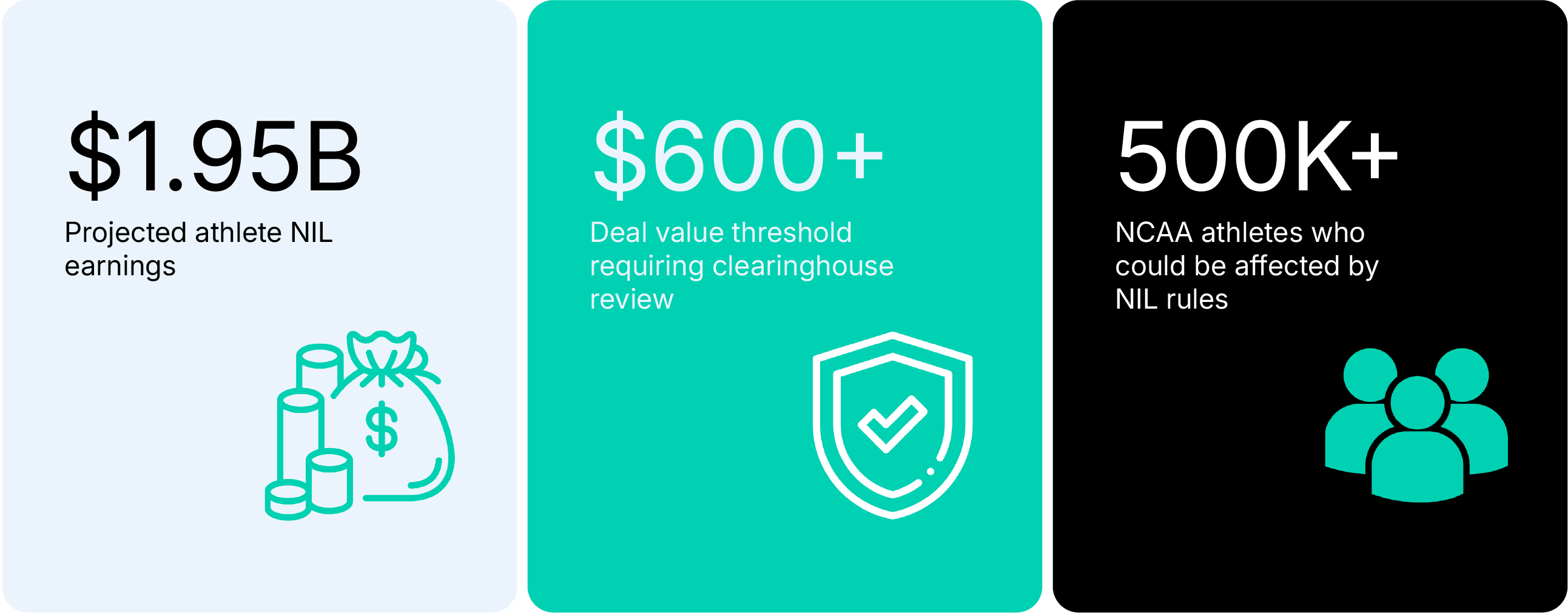
College athletes are sitting on the fastest-growing, least-protected slice of this market. Since the NCAA's 2021 rule change, name, image, and likeness deals have gone from nonexistent to a market projected to generate roughly $1.95 billion in athlete earnings between mid-2025 and mid-2026.
The College Sports Commission's NIL Go clearinghouse now reviews every third-party deal over $600 for fair market value, and tens of thousands of athletes use that system every week. A single college athlete with a strong social profile can be juggling a dozen separate NIL deals with a dozen separate sets of obligations, and almost none of them get the legal review a professional contract would.
This is one of the clearest use cases for AI sports contract analysis going forward. The automated conflict checks between overlapping sponsor deals, valuation modeling based on real social reach, and compliance screening against state-by-state NIL law before dealing.
Signing Day Looks Completely Different Now
Digital contract signing for athletes now routinely includes a final automated pass before the signature page. A final check for clauses that conflict with an existing endorsement, a salary-cap or roster-rule compliance scan, and in some federations, blockchain-verified timestamps that make a signed agreement tamper-evident.
The final analysis before signature is what AI-powered sports compliance actually means in practice, not a vague promise of "smart contracts," but a concrete gate that catches a conflicting clause before it becomes a dispute six months later.
Is AI Coming for the Sports Agent's Job?
Not as such; it only changes which agent is paid too much. Agents who adopt AI tools are spending less time manually combing clauses, and more time on the parts of the job a model can't do: relationship-building, negotiation leverage, and reading a front office's intentions.
Agents who have not adopted AI tools lose their place in the market, while those who integrate AI into their work are likely to have more clients. The likely outcome isn't AI replacing agents it's a market that increasingly expects every agent to be AI-augmented, the same way every athlete is now expected to walk into the table with a basic risk summary already in hand.
What Could Go Wrong: Bias, Privacy, and Accountability
None of this is risk-free. Legal researchers have already flagged that predictive models trained on historical contract and performance data can replicate the same biases present in that data. It under-evaluates athletes from lower-profile leagues, smaller markets, or underrepresented backgrounds. There's also a genuine accountability gap: when an AI tool clears a clause that later proves problematic, it isn't always clear who's responsible the platform, the agent who relied on it, or the athlete who signed.
The honest position is that AI should narrow the information gap between athletes and the teams or agencies on the other side of the table, not replace human legal judgment entirely, especially on six- or seven-figure decisions.
Five Questions Athletes Should Ask Before Signing
- Has this contract actually run through a proper AI risk scan?
- Does this deal conflict with any existing sponsorship or NIL agreement I've already signed?
- What exactly triggers each performance bonus, and who tracks it?
- What happens to this contract if I'm injured for an extended period?
- If an AI tool flags a risk, who has final say: me, my agent, or the platform?
Final Thoughts
This shift in how athletes review and sign contracts isn't a future promise; it's already happening. Amrood Labs has been building this exact future, and Sportiv.ai is the clearest proof: a working contract intelligence engine already used by real sports professionals. If you're thinking about building something similar, we'd love to help you build it right.
Table of Content
Share Now
.png)



.png)