
How to Hire a Sharetribe Developer for Your On-Demand Marketplace


Building an on-demand marketplace takes more than a site where buyers and sellers connect. What you need is an easy booking process, a secure payment method, cancellation policies, and a reliable system.
You've chosen Sharetribe, a smart pick since it's built for marketplaces, not an off-the-shelf online store with a plugin bolted on. But selecting the platform was the easy part. The harder question is who builds on it, especially for on-demand marketplaces, where customers need a provider now, not next Tuesday.
The right developer adapts the platform, integrates tools, and builds custom workflows. The wrong one costs you time, money, and control. This guide covers what to look for, what it costs, and what to ask before signing.
Do You Really Need a Sharetribe Developer?
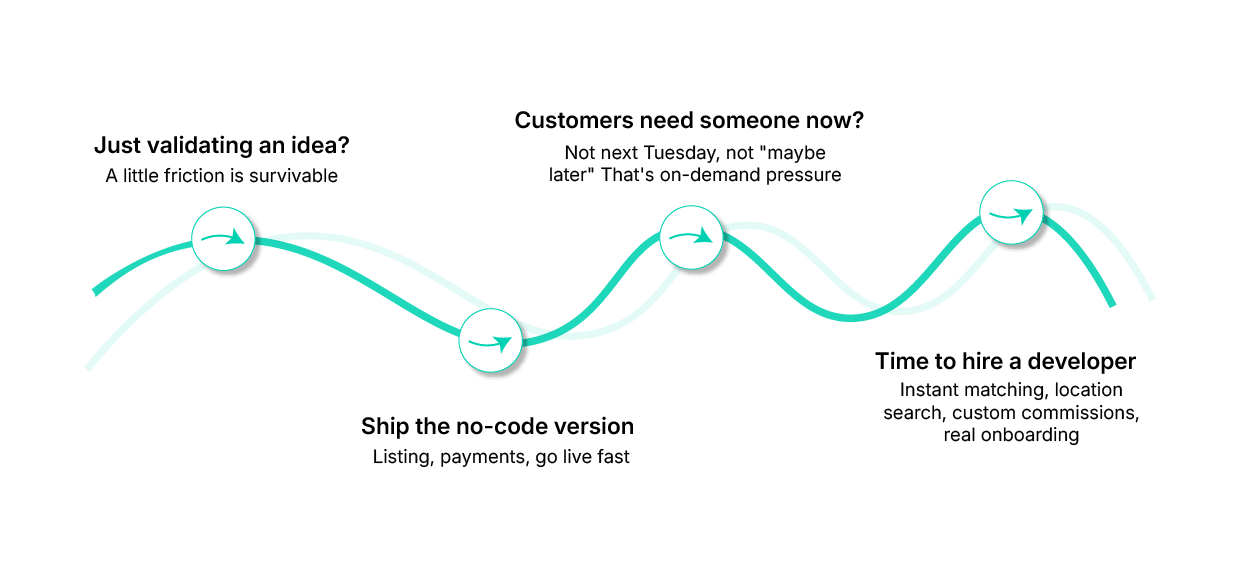
Not every marketplace needs custom development from the beginning. For example, a rental marketplace can tolerate a little friction. Someone books a listing, waits for confirmation, maybe messages back and forth. An on-demand marketplace can't.
If you are testing a simple idea, Sharetribe's built-in features may be enough to launch an early version. You can create listings, define categories, set up payments, manage users, and start validating demand.
You may need to hire a Sharetribe developer when your business requires more advanced features, such as custom booking or transaction flows
- Special provider onboarding steps
- Location-based search
- Custom commission rules
- Third-party payment systems
Another example, a cleaning marketplace may need customers to choose a date, time, property size, cleaning type, and preferred provider.
A delivery marketplace may need location tracking, route data, automated assignments, and delivery-status updates the same real-time data pressure that logistics platforms deal with at scale.
These features often require more than basic platform configuration. A Sharetribe developer can help turn those operational requirements into a working product.
Know Which Sharetribe You're Actually On
This trips up more founders than it should. Sharetribe has gone through a few iterations, and the version you're on determines what's even possible:
- Sharetribe Go: the older, no-code version. Visual customization only, limited flexibility, no native mobile apps. Fine for a quick MVP, a dead end for on-demand.
- Sharetribe Flex: (now folded into the current unified Sharetribe platform) headless, API-first, built on a React front end, fully customizable transaction logic. This is what you need for an on-demand build.
If a developer you're talking to doesn't immediately ask which version you're on, or doesn't know the difference between Go and the current API-based platform, that's a red flag before you've even gotten to pricing.
What a Sharetribe Developer Actually Builds for an On-Demand Platform
A Sharetribe developer works on the technical side of your marketplace. Their responsibilities depend on your platform, users, business rules, and growth plans.
A developer may customize your marketplace frontend, create new pages, change listing flows, connect third-party services, or develop additional backend functions outside Sharetribe.
Here are some of the main areas a developer may handle.
Frontend Development
The frontend is the part of your marketplace that users see and interact with. A Sharetribe developer can change the layout, navigation, listing pages, search experience, provider profiles, checkout process, and customer dashboards.
They may also improve the mobile experience so customers and providers can use the marketplace more comfortably from phones and tablets, a common reason marketplaces move towards custom mobile app development support once they outgrow a browser-only experience.
Custom Marketplace Workflows
Every on-demand marketplace operates differently.
A home-services platform may allow providers to accept or reject requests. A rental marketplace may require date-based availability. A consultation platform may need scheduled calls and automatic reminders.
A reliable Sharetribe developer can help map these workflows and build the required transaction steps.
This may include:
- Booking requests
- Provider approval
- Payment authorization
- Order confirmation
- Service completion
- Refund requests
The developer should understand both the technical process and the way the marketplace operates.

API Integrations
Most marketplaces depend on several external tools, and connecting them safely is really its own discipline of CRM integration work. You may need to connect Sharetribe with:
- Stripe
- HubSpot
- Mailchimp
- Google Maps
- Twilio
- Zapier
A qualified Sharetribe developer should know how to connect these services safely and how to manage errors when one system stops responding.
Performance and Maintenance
Custom development does not end on launch day. Your marketplace may need updates, bug fixes, dependency reviews, performance improvements, and support for new Sharetribe releases.
The trusted developer should explain how they manage ongoing maintenance before the project begins.
Where to Find Sharetribe Developers
There are four realistic routes, and each has a different trade-off between cost, vetting, and reliability.
If your budget is tight and the scope is narrow, like developing custom CSS, a single integration, or small UI tweaks, freelance Sharetribe developers on Upwork can be a reasonable, affordable option. Once you're building real-time matching, dispatch logic, or a mobile app from scratch, an agency or a Sharetribe-vetted expert is usually worth the premium, because the cost of a process is much higher than the savings on an hourly rate.
How to Hire a Sharetribe Developer
Everyone says to check past work. Fewer people tell you what to actually ask. Try these:
- "Walk me through how you'd structure the transaction process for an instant-match, on-demand booking." A developer who's actually done this will talk about Sharetribe's Transaction API and process states without hesitating. Someone who hasn't will talk in generalities.
- "What's not customizable in Sharetribe, and where would you need to build outside it?" This tests whether they understand the platform's real boundaries, not just its marketing page.
- "How would you handle a provider going offline mid-job?" There's no single right answer, but a real developer will have opinions and trade-offs, not silence.
- Ask for a small paid test task before committing to the full build something like implementing one custom transition in the transaction process. It's a cheap way to see how they actually work, not just how they interview.
How Much Does It Cost to Hire a Sharetribe Developer?
The cost depends on the size and complexity of the project. A small design change may take a few hours. A custom marketplace with advanced workflows, several integrations, and a new frontend may require months of work.
Main cost factors include:
- Number of custom features
- Complexity of transaction logic
- Number of integrations
- Quality of existing code
- UX and design requirements
- Testing needs
- Mobile development

These same cost drivers show up when comparing React.js developer rates, scope and complexity move the price far more than the hourly number alone. When comparing proposals, do not look at the total price alone.
Check what each proposal includes, what it excludes, how many revisions are allowed, who performs testing, and whether post-launch support is included.
Questions to Ask Before Hiring Sharetribe Developer
A good interview should test both technical knowledge and communication.
Ask candidates:
- Which Sharetribe projects have you worked on?
- What parts of our project can use standard Sharetribe features?
- Which requirements need custom code?
- How would you structure our transaction process?
- Have you built custom booking or availability logic?
Pay attention to the questions the developer asks you as well. A serious developer should want to understand your users, operations, revenue model, transaction rules, and future plans before giving a final estimate.
Common Mistakes Founders Make
- Assuming any React developer can handle Sharetribe.. React is the front-end language; Sharetribe is a full system with its own API structure, transaction logic, and customization limits. Knowing one doesn't mean knowing the other.
- Skipping a written scope before requesting quotes. Without a defined MVP feature set, quotes from different developers won't even be comparable.
- Choosing based purely on the lowest hourly rate. On-demand transaction logic is not simple CRUD work cheap-and-inexperienced usually costs more later in rework.
- Building all platforms (web, iOS, Android) at once. Prove the model on one surface first.
- Not planning for maintenance. A marketplace isn't a one-and-done project; treat post-launch support as part of the budget, not an afterthought.
Warning Signs to Watch For
Be cautious when a candidate:
- Promises every feature without discussing limitations
- Gives a final price without reviewing the scope
- Cannot show previous marketplace work
- Avoids questions about testing
- Gives unclear answers about security
- Refuses to define milestones
- Pushes you to start before requirements are documented
Low pricing can also be a warning sign when the estimate is far below every other proposal. The cheapest option may become expensive when another developer has to repair incomplete or poorly documented work.
Run a Paid Trial Project
Before awarding a large contract, consider hiring the candidate for a small paid task.
Possible trial projects include:
- Reviewing your technical requirements
- Auditing an existing Sharetribe marketplace
- Creating a development estimate
- Building one search filter
- Adding one listing field
- Connecting a simple third-party service
Use the trial to assess communication, planning, technical quality, testing, and documentation. A small project can reveal more than several interviews.
Final Thoughts
Hiring the right Sharetribe developer is one of the most important decisions you will make while building an on-demand marketplace.
Start by defining your users, transaction flow, essential features, integrations, budget, and timeline. Then compare developers based on direct Sharetribe experience, marketplace knowledge, technical skills, communication, testing, and documentation.
Whether you choose an agency such as Amrood Labs, an in-house employee, or freelance Sharetribe developers, keep control of your code, accounts, credentials, and technical records. A clear brief and a careful vetting process will help you hire a Sharetribe developer who matches your current needs and gives your marketplace room to grow.
Table of Content
Share Now
.png)




Learn why parallel Git branches create duplicate migration numbers and how to fix migration conflicts using GitHub Actions. Includes workflow code, testing strategies, and database migration tools.

Six real JWT vulnerabilities, working exploits, and the fixes that stop them. Includes OWASP guidance and a 2026 JWT security checklist for developers.

Couldn't fetch" isn't just a random issue; it means your sitemap index URL doesn't exist. See why Next.js does this and how to generate it yourself.

