
Custom Web App Development vs. Off-the-Shelf Solutions: Which Is Right for Your Business?
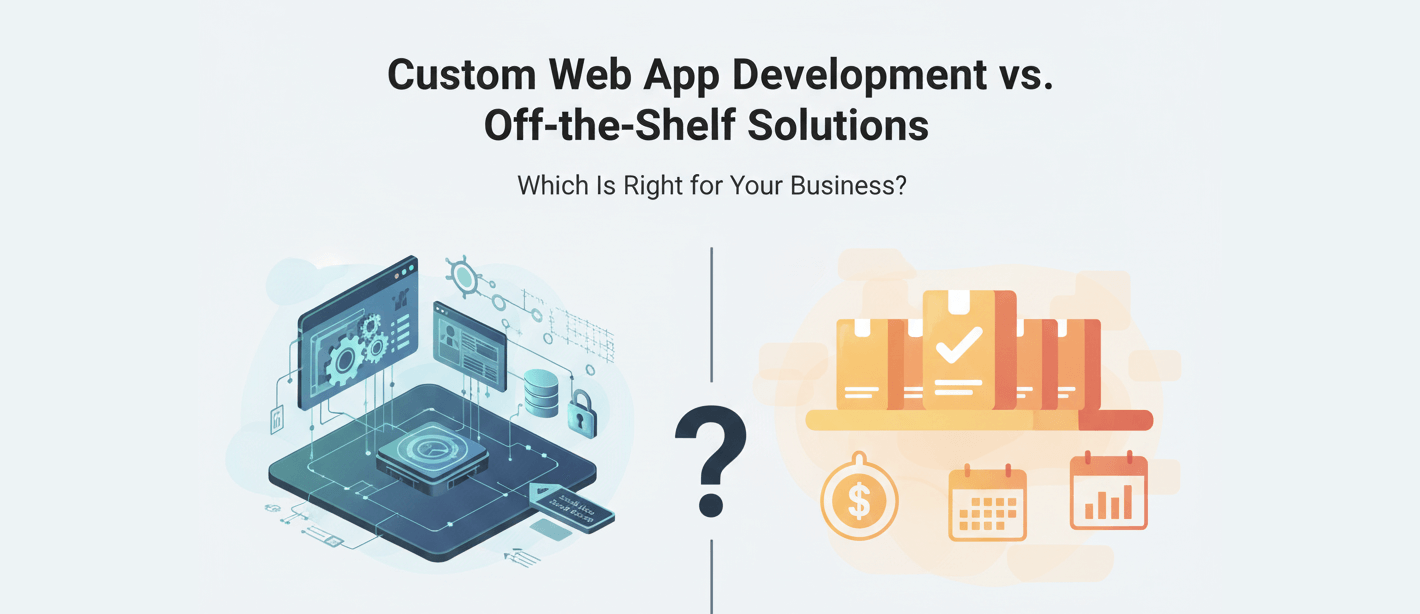

Choosing the right type of software is a decision that can significantly affect your productivity and the scalability of the project. Whether you are going to launch a new startup or build your own brand, one of the most common questions you will have is to make the wise decision between custom web development or an offshore software solution.
Each option has its own advantages and limitations in the process of selection, depending on the business need, timeframe, and budget. The application you use to provide services to clients will have a major impact on the organization's efficiency and scalability.
In this blog, we will deeply analyze both approaches to help you make the right decision for your project.
What Is Custom Web Application Development?
Custom web application development means building software from the ground up. This means your tool is made to match your company’s workflow, goals, and customer experience. It won’t come with extra features you don’t need. Instead, it focuses on what matters to you.
It’s often used by growing businesses or companies with special needs. A web application development company will design and build this type of app just for you. That means it fits your needs exactly. This process involves planning, design, coding, and testing. Most web app development companies also provide ongoing updates and support.
For example, a logistics company might need special tools for delivery tracking. A custom system could include real-time maps, route planning, and package scanning, while these tools wouldn’t be available in most off-the-shelf options.
Advantages of Custom Web App Development
Several benefits of custom development make it easier to serve customers better and manage internal systems more smoothly. You also reduce the need for third-party add-ons or manual workarounds, saving time each day.
- It fits your business perfectly.
- You control every feature and function.
- You can scale it as your business grows.
- It’s easier to integrate with other systems.
- You get better control over security and privacy.
Custom apps grow with your business. Someone else’s roadmap does not limit you. When you use custom web application development services, you’re investing in something that lasts. Many teams also find that custom application development leads to fewer workarounds and faster tasks. In many cases, these apps evolve with your business, offering long-term support that generic tools can’t.
Disadvantages of Custom Web Development
Some businesses find the process overwhelming or too slow, especially when speed is critical. If your needs might change often, custom software may feel too rigid. Working with a custom web application development services team requires ongoing communication and strong project management.
- It costs more up front.
- It takes more time to build.
- It needs planning, testing, and feedback.
- You need a clear vision before starting.
If you are managing a small team, just starting the setup, or have a limited budget, these issues are difficult to tackle. A web development company may take weeks or months to finish your app. And if plans change mid-project, it could add time and cost. A startup that only needs basic features might struggle with this approach. For them, backend development services or a simple hosted tool could work better.
What Are Off-the-Shelf Web Solutions?
Off-the-shelf software is pre-built and ready to go, which means that you only have to sign up and start it on the spot. These tools are specifically designed for a broader audience, so they have generalized features. This makes them great for common tasks like managing contacts or publishing content quickly. You don’t build it from scratch; instead, you buy it, subscribe to it, or download it. Many web development agencies offer this type of setup.
These tools are for the mid-level user as there is no need to have technical knowledge or to write clean code. That means you can launch faster and spend less time training your team. If you need something simple, these tools are often more than enough for the short term. You might find these as website builders, store platforms, or booking systems.
For example, a small bakery might use an online tool like Wix or Shopify. These platforms offer ready-made templates, shopping carts, and payment tools. Using e-commerce web development services, the bakery can go live fast.
Pros and Cons of Off-the-Shelf Solutions
Advantages
- It’s usually cheaper at the start.
- There are many templates and features.
- It often comes with support.
- There is no need to write code.
It works best when the speed and simplicity are your top priorities. Many web development company teams help you choose and customize these tools slightly to get more out of them. They also offer easy integration with popular services like payment systems and email marketing.
Disadvantages
- Custom changes are limited.
- Scaling might be hard later.
- Security is shared with other users.
- You rely on a vendor for updates.
- It may not meet every need.
Off-the-shelf tools are like renting software. It works but you don’t own it.
Many businesses work with an ecommerce web development company to launch these tools. A web development company can help make them look more custom, but there are still limits. Some off-the-shelf solutions can even lock you in, making it hard to migrate later.
Custom vs. Off-the-Shelf Software: A Comparative Analysis
Cost and Time-to-Market
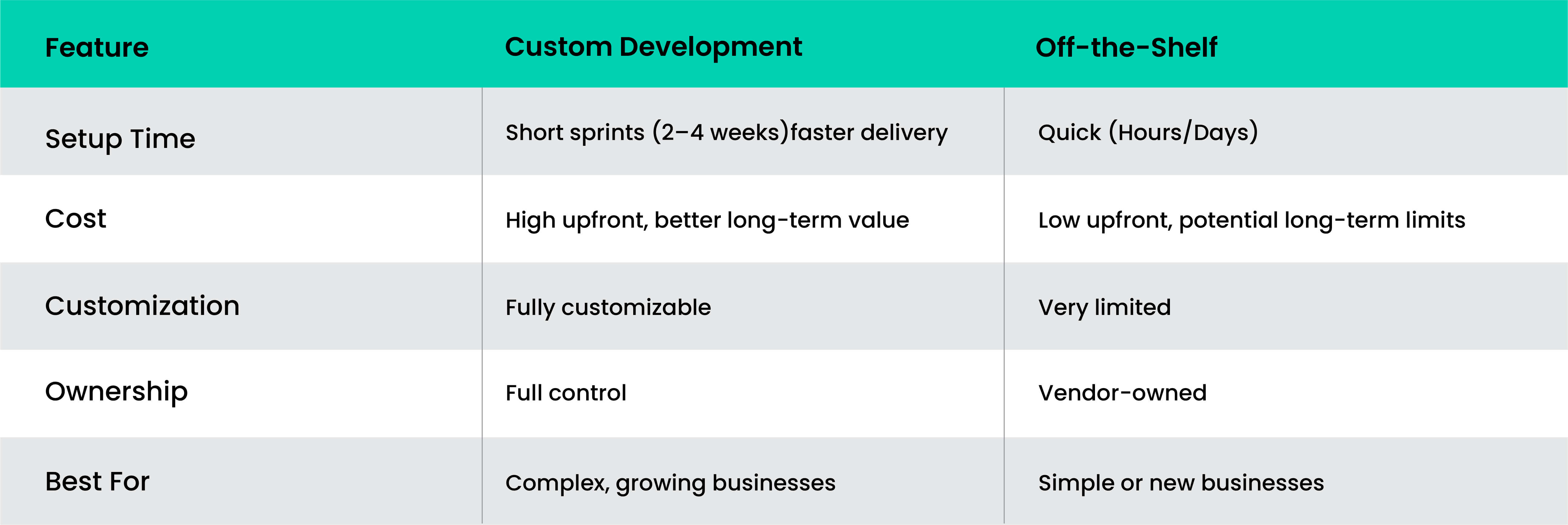
Due to its requirements, including development, design, and testing phases, custom software development usually involves a higher cost and a longer timeline. Conversely, off-the-shelf options are more affordable and produce results faster.
However, organizations should consider the total cost of ownership (TCO). Commercial software might have subscription fees, license fees, and per-user price schemes that add up over time. A custom-built system might, in some cases, result in greater financial efficiency over a period of five to ten years.
Scalability and Flexibility
When a business grows, custom apps are designed to grow with it. This allows the team to add features at run time and build the app that runs more smoothly, and redesign the app structure according to the needs of the business.
In contrast, off-the-shelf tools can be scaled within certain limits, but they might not allow for as much flexibility or extensibility. As the process becomes complex, companies might be forced to switch platforms or use multiple tools to make up for the things that are not functional.
Integration Capabilities
ERPs, CRMs, data warehouses, and proprietary services are examples of internal systems that can be natively integrated with custom solutions. Deeper data synchronization, automation, and process optimization are made possible by this. Third-party connectors or publicly available APIs are frequently used to integrate off-the-shelf applications. These mechanisms might not allow sophisticated data flows, or highly tailored automation requirements.
Security and Compliance
Custom software allows organizations to define and enforce security controls aligned with specific risk profiles. This includes role-based access control, encryption standards and compliance with frameworks such as GDPR, HIPAA, or SOC 2. Off-the-shelf products are designed for broad audiences and typically implement generalized security measures.
When to Choose Each Option
Choose Custom When:
- You have a unique product or service.
- You want to grow or scale long term.
- You need strong data privacy or legal protection.
- You have a skilled team or partner.
Example: A private clinic may choose a custom web application development company to build a secure, HIPAA-compliant patient portal. It gives you a guarantee about the security of patient data and supports the unique appointment needs.
Choose Off-the-Shelf When:
- You need to launch fast.
- You have a small budget.
- You’re testing a business idea.
- You need something simple.
- You don’t require personalized elements.
Example: A first-time entrepreneur might use Amazon or Shopify to see the scented candles online. It’s fast, low-cost, and doesn't require development. Working with a web app development company helps you decide. They can walk you through the planning process, highlight risks, and suggest a mix of tools if needed. In some cases, companies start with off-the-shelf tools and slowly move toward custom web development as they grow.
Final Thoughts
Every organization has different requirements; what works best for one team doesn’t work well for others. Off-the-shelf apps are the best opportunity for getting started quickly. They are cost-effective and help in testing the ideas at different stages. By thinking ahead of time and arranging things according to your company size, industry, and missions, you avoid costly mistakes.
On the other hand, custom web development services give you the control and tools you need to scale. Undoubtedly, they consume time and are expensive, but they will pay you back later.
Whether you’re launching a store or building internal tools, a trusted custom web application development company such as Amrood Labs can guide you. Even if you start small, you can always grow. And if you're not ready to build in-house, you can outsource web development to expert teams.With the right team and plan, web application development can power your success for years.
Table of Content
Share Now
.png)



.png)
Learn why parallel Git branches create duplicate migration numbers and how to fix migration conflicts using GitHub Actions. Includes workflow code, testing strategies, and database migration tools.
Six real JWT vulnerabilities, working exploits, and the fixes that stop them. Includes OWASP guidance and a 2026 JWT security checklist for developers.
