
Why Logistics Platforms Fail Under Real-Time Data Pressure
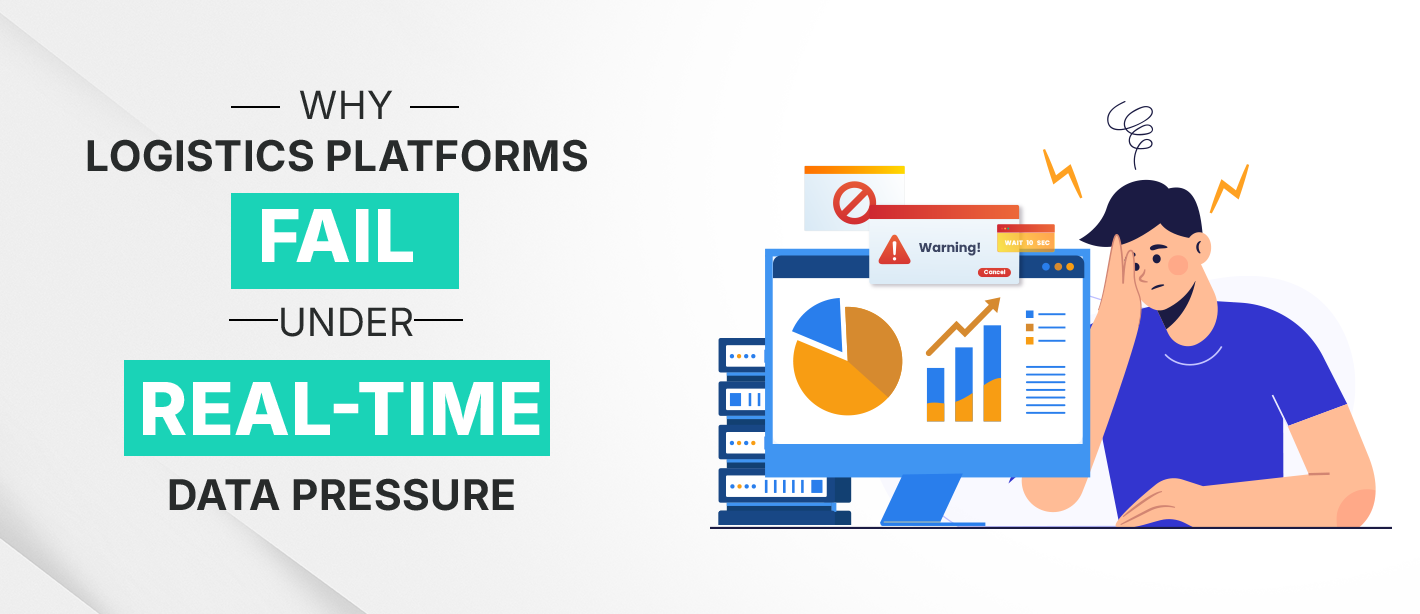

Modern logistics platforms promise efficiency, speed, and visibility, yet many of them crumble under the weight of the real-time data they were designed to handle. The need for dynamic decision-making and minute-by-minute updates increases as logistics companies grow. Businesses soon discover that handling these data streams is a strategic minefield rather than merely a technological challenge.
So why do platforms that seem sound in theory falter in practice?
The answer depends on the infrastructure capabilities, misaligned expectations, and complex processes across the market of stakeholders. From asset-light startups to enterprise SaaS tools, many logistics platforms hit the same pitfalls, and in a time-sensitive, disruption-prone industry, failure to meet real-time demands can erode trust, lose customers, and sink businesses.
Let’s explore why this happens, what the warning signs are, and how to approach logistics technology differently in an always-on, real-time world.
1. The Data Flood Isn’t the Problem Latency Is
Real-time logistics data doesn’t trickle in; it floods. From GPS tracking and IoT sensors to traffic updates, weather data, and warehouse scans, platforms must ingest, process, and act on thousands of micro-events per second. It is not a matter of speed; instead, it's all about the variability and volume.
Systems not only store the data, but also validate its accuracy and relevance before pushing it downstream to analytics or operational systems.
The technical demand is staggering:
- Low-latency pipelines
- Scalable data infrastructure
- High availability under stress
- Instant decisioning and error handling
Many platforms buckle because they were designed for periodic batch updates, not continuous ingestion. This mismatch leads to lag, data loss, and user frustration, the very opposite of what “real-time” is supposed to deliver. In high‑velocity environments like logistics, hiring an AI developer early helps prevent latency from becoming a structural failure.
2. Misaligned Architecture Kills Scalability
At early stages, many logistics platforms run lean on one managed cloud services provider, simple ETL scripts, and off-the-shelf tracking APIs. As data streams multiply and customers demand deeper insights, these lightweight stacks start failing.
Rigid architectures are unable to accommodate dynamic routing, event-driven processing, or scaling over dispersed geographic locations. Every extra user, sensor, or vehicle adds to the pressure when real-time systems are put together on a rigid or monolithic foundation.
The architectural missteps often include:
- Overuse of third-party APIs with rate limits
- Single-point cloud dependencies
- Lack of event-based microservices
- Absence of buffering for data spikes
Without redesigning the architecture to support horizontal scaling, platforms face downtimes, delayed updates, or worse, incorrect information going out to customers. In cases where data integrity and backend governance break down, companies often choose to hire Python developers to redesign ingestion and validation workflows.
3. Commoditized Freight Still Runs on Trust
Freight may be data-driven now, but it remains a relationship business. Too many logistics platforms over-index on automation and strip out the human layer entirely, assuming that real-time dashboards and automated alerts are enough.
A website development services company might design a financial dashboard with real-time portfolio tracking — and assume those same principles apply to logistics. But logistics data flows are spatial, temporal, and interconnected with physical goods, people, and unpredictable external conditions.
But in many scenarios, especially high-stakes or cross-border logistics, customers still expect accountability, flexibility, and person-to-person problem-solving.
Real-time data must augment, not replace, the human side of logistics.
Failing to preserve that interpersonal element causes friction:
- Miscommunication when real-time feeds go silent
- Lack of empathy during service disruptions
- No escalation paths beyond automated systems
The smartest platforms integrate real-time updates with live agent support, proactive customer communication, and explainable decisions. That’s how technology becomes an enabler, not a barrier.
4. Data Volume Outpaces Data Governance
Real-time data pressure isn’t just about quantity it’s about quality.
Poorly governed data environments often crumble when real-time operations kick in. Missing timestamps, inconsistent formats, and duplicate events create noise that distorts decision-making. Over time, that noise becomes a liability, misrouted shipments, incorrect ETAs, and misinformed logistics decisions.
Without a mature data governance framework, real-time data becomes a source of confusion, not clarity.
Trying to retrofit generic financial web applications infrastructure into logistics systems often leads to brittle interfaces, incompatible workflows, and poor user experiences.
Similarly, using a generic financial advisor web application template won’t help when managing time-sensitive cargo routing, cross-border customs, or dock scheduling.
Key governance gaps include:
- No unified data model across modules
- Inconsistent data ownership between engineering and ops
- Lack of audit trails for decision logic
- Absence of compliance protocols for cross-border data
Logistics platforms that scale sustainably invest early in metadata management, schema enforcement, and data lineage, treating data as infrastructure, not exhaust.
5. Real-Time Systems Strain Security and Compliance
As data velocity increases, so do the risks. Real-time logistics platforms process sensitive customer, inventory, and routing data, making them prime targets for cyberattacks.
When IoT devices, mobile trackers, and third-party integrations expand the attack surface, even minor breaches can have major downstream consequences. Security often lags behind the innovation curve in logistics tech.
Common weaknesses include:
- Hardcoded credentials in fleet devices
- Insecure APIs between supply chain partners
- Limited encryption for in-transit data
- No real-time breach detection or response plans
In sectors like healthcare logistics or defense, real-time data compliance becomes even more critical. Platforms must align with global data privacy laws and industry-specific regulations while maintaining performance.
Building trust in logistics tech isn’t just about performance; it’s about protecting every data point flowing through the system.
6. Talent Bottlenecks Break the Feedback Loop
Real-time data systems aren’t just plug-and-play. They require:
- Data engineers to build resilient pipelines
- Analysts to spot anomalies and trends
- Operations teams to interpret and act on insights
But logistics tech often suffers from a talent gap. Either the team is too lean to monitor high-velocity systems or lacks the cross-functional skills to make data actionable in the field. To improve routing logic and operational intelligence, many companies now hire LangChain developers to connect real‑time signals with explainable decision workflows.
Without skilled personnel and feedback loops, platforms fall into a reactive posture:
- Issues surface only after customers complain
- Routing logic doesn’t improve over time
- Delays are blamed on tech, not operations
Scaling real-time logistics systems requires upskilling across roles, not just developers, but dispatchers, warehouse managers, and support staff who can use real-time insights to make smarter calls.
7. “Real-Time” Doesn’t Always Mean Real Value
A common failure mode is building a platform that displays information but doesn’t reduce uncertainty. Many products can show dots on maps and lists of milestones. Far fewer can answer the operational questions that actually matter:
- Which loads will miss their appointment window?
- Which delays will trigger penalties or claims?
- Which lanes are trending worse this week and why?
- Which carrier behaviors correlate with service failures?
Real-time data only matters if it changes decisions. If the platform doesn’t connect signals to actions—reroute options, exception playbooks, inventory rebalancing, proactive customer messaging it becomes a passive screen. Under pressure, passive screens get ignored.
This is where a strong product strategy looks “weird” but wins:
- Define the decisions the platform must improve
- Quantify the cost of a late or wrong decision
- Build workflows that turn signals into specific actions
- Measure adoption by actions taken, not logins
When speed is applied with intent, real-time becomes a tool, not a vanity metric.
Asset-Light Models Collapse Under Real-Time Constraints
Some platforms position themselves as neutral coordinators of capacity: connect shippers and carriers, orchestrate transactions, and optimize matching. The problem is that “coordination” becomes unstable under real-time pressure unless the platform controls enough of the operating system standards, processes, enforcement mechanisms, or assets to guarantee execution quality.
In real-time conditions, small weaknesses compound:
- Carrier availability changes by the hour
- Tender acceptance patterns shift during disruptions
- Appointment slots disappear quickly
- Detention risk rises with congestion
If the platform can’t influence outcomes beyond “sending requests,” it becomes a messenger rather than a system. And messengers get bypassed. Carriers and shippers revert to direct communication because direct communication is faster and more reliable when conditions change minute to minute.
This doesn’t mean every platform must own trucks or warehouses. It does mean platforms need leverage: standardized workflows, strong SLA enforcement, embedded communication, dispute resolution, and integrated operational tooling that makes the platform the easiest path, not an extra layer. Without leverage, real-time complexity turns an intermediary into friction.
Final Thoughts
Logistics platforms fail under real-time data pressure for a predictable set of reasons: batch-era assumptions, integration debt, weak decision support, misaligned incentives, unstable intermediary models, cycle-blind strategy, and thin observability. None of these problems is mysterious, and none requires interesting solutions. They require teams to treat real-time reliability as a first-class product constraint, not a performance enhancement to add later.
The platforms that endure make a clear promise: data users can trust, at the speed operations require, connected to the decisions that reduce cost and risk. They design systems that support people rather than replace them. They measure outcomes, not interface activity.
At Amrood Labs, we understand that real-time data is just the beginning. The real challenge and opportunity lies in how logistics platforms translate speed into sustained success.
People Also Ask
Why do logistics startups struggle with real-time scalability?
Startups often launch with minimal infrastructure. As demand grows, data volume explodes. Without flexible architecture and robust data pipelines, they can’t handle real-time pressure, resulting in performance issues.
How can you tell if a platform is truly real-time or appears that way?
A real-time system shows data freshness, explains signal sources, and handles conflicting events automatically. If updates rely on refresh cycles or hidden corrections, the platform only looks real-time but cannot support operations.
Why do integrations cause so many failures in logistics platforms?
Many partners provide logistics data with varied identities, formats, and timestamps. Under real-time load, minute errors compound quickly. Integrations inject faults quickly than teams can fix them manually without good mapping and governance.
What questions should teams ask vendors to assess real-time reliability?
How soon do events update, conflicts settle, and data freshness is measured? Reliable vendors clarify lineage, delay, and failures. Vague replies, dashboards alone, and buzzwords indicate vulnerable real-time systems.
Table of Content
Share Now
.png)



.png)
Learn why parallel Git branches create duplicate migration numbers and how to fix migration conflicts using GitHub Actions. Includes workflow code, testing strategies, and database migration tools.

Six real JWT vulnerabilities, working exploits, and the fixes that stop them. Includes OWASP guidance and a 2026 JWT security checklist for developers.
