
Ruby on Rails vs. Django: Which Framework Should You Build & Hire For in 2026?


Selecting between Ruby on Rails vs Django is beyond a framework decision. It’s a major step that affects the speed of product launch, your team's performance, and how easily your product scales over the next 2 years. Both frameworks are battle-tested, widely used, and capable of powering billion-dollar products.
Ruby on Rails developers are mostly hired by companies such as Shopify and GitHub, while Django supports social platforms such as Pinterest and Instagram. Both are different from each other in a way that one moves faster, while the second one provides you with flexibility with a defined structure.
This article will help you get a detailed comparison between two frameworks: Django and Ruby on Rails. We will break down its features, scalability with real examples, so that at the end you will be able to decide which fits to build your product.
What's Actually Different in 2026- Ruby on Rails vs Django
Before we compare the details, it’s worth noting one big shift: AI is now a normal part of many modern web products, not just an extra feature.
This gives Django an advantage in some cases because it works within the Python ecosystem. That means your team can use tools like NumPy, Pandas, PyTorch, and scikit-learn more easily, without always needing to build a separate service for AI or data-heavy features.
Rails is still very strong in another area. With Rails 8, it has improved how teams build fast, server-rendered web apps using tools like Hotwire. This makes Rails a great choice for traditional web applications that need to launch quickly and feel responsive.
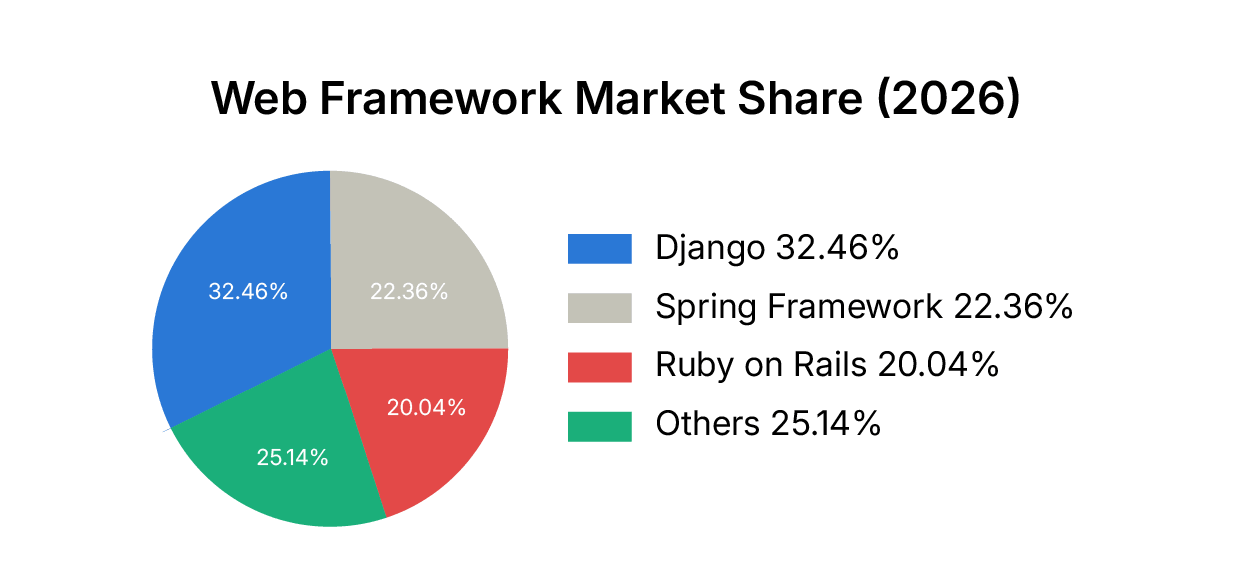
Market share tells part of the story. According to 6sense's Web Framework, Django currently holds a 32.46% share in the web framework category with over 36,000 active customers, while Rails holds 20.04% with around 22,000 active customers. Neither is going anywhere but Django's broader adoption reflects Python's dominance in both education and enterprise hiring pipelines.
This Django vs Ruby on Rails quick comparison is designed not just from a developer's point of view but also for product development. If you're still weighing your options at this stage, it sometimes helps to talk through your specific use case with a team that builds in both stacks. Amrood Labs' custom web development services cover both Rails and Django projects and can help you map the decision to your actual product.
Development Speed: Where Each Framework Wins
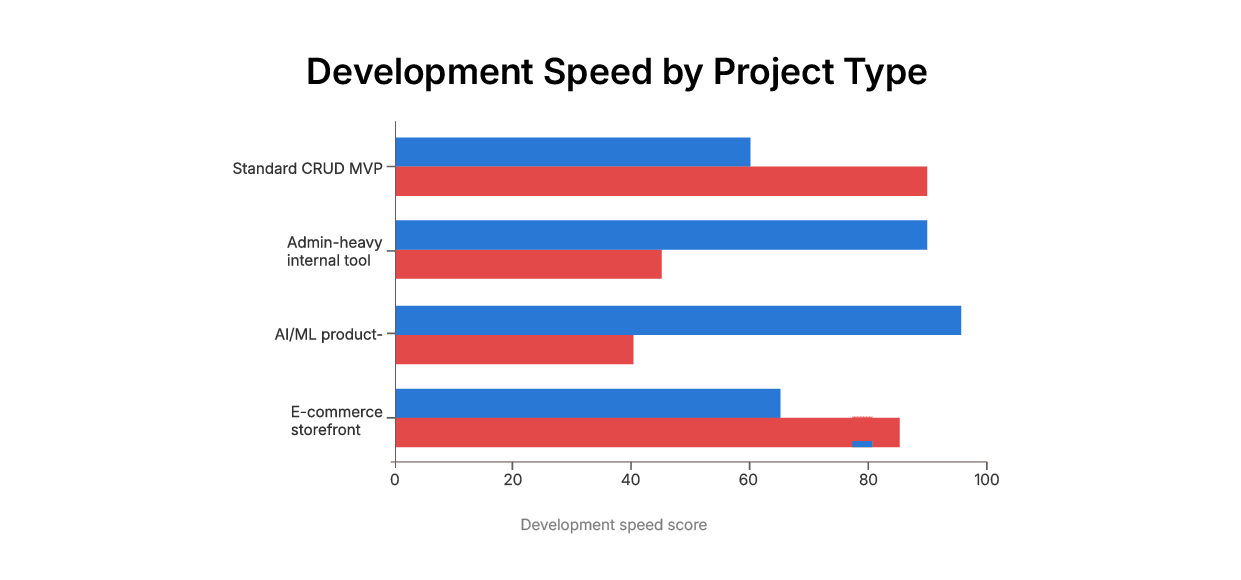
Rails gets you to market faster on standard web applications. It follows a “convention over configuration” style, which means developers do not have to make as many small setup decisions. Things like naming, routing, and relationships between data models are already handled in a familiar way. Studies from production teams show Rails delivers working CRUD-heavy applications roughly 30–40% faster than an equivalent Django project.
Django, though, has its own speed advantage: the automatic admin panel. Before you write a single line of business logic, you have a fully functional back-office dashboard to manage users and data. For teams building internal tools or data platforms, this saves weeks of development time that Rails would require gems and custom configuration to replicate.
The honest answer on Ruby on Rails vs Django performance for development speed: it depends on what you're building. Rail wins on consumer web apps. Django wins when your data model is complex.
Scalability & Architecture
Both Rails and Django can handle large amounts of traffic. GitHub and Shopify use Rails. Instagram and Pinterest have used Django. So, the framework itself is usually not the main problem when an app starts growing.
Most scaling issues stem from other areas, such as database structure, caching, background jobs, hosting setup, and application planning.
That said, Django 5's native async views give it a meaningful edge for high-concurrency workloads. This is useful for products that deal with real-time data, background processing, or AI features that run during a user request.
Rails can also handle these needs, but it may require more setup depending on the project.
There is also a practical middle path. Many teams run Ruby on Rails development for their web layer and a lightweight Python microservice for ML inference.
This gives the team the speed of Rails for building product features, while still using Python tools where they are needed most. This hybrid approach lets you keep Rails' speed for shipping product features while connecting to Python's AI ecosystem where it matters.
One thing worth knowing: you don't have to pick just one forever. A lot of teams run Rails for their core web app and connect a small Python service for anything ML-related. It's a clean split and it works well in practice and it's a common pattern Amrood Labs builds through its AI solutions practice when a Rails product needs to add machine learning features without a full rewrite.
Rails vs Django Performance: Security
Django is the stronger choice out of the box. It ships with built-in protections for SQL injection, CSRF, XSS, clickjacking, and SSL/HTTPS configuration covering nearly every major web vulnerability before your first deployment. This makes it the default choice for fintech, healthcare, and enterprise applications where a security audit is part of the launch process.
Rails is not weak on security it covers CSRF, XSS, SQL injection, and secure password hashing with bcrypt by default. But Django's additional layers (clickjacking headers, strict content security policies, and configurable permission systems) give compliance-focused teams fewer third-party dependencies to manage.
For regulated industries, Django wins the Rails vs Django performance comparison on security without much debate.
Hiring Reality Check: Django and Rails Developer
This is where Ruby on Rails vs Django becomes a business decision, not just a technical one.
Hiring Ruby on Rails Developers
Hiring an ROR developer takes more time and costs more. Here's what to expect:
- Most Rails developers you'll find have 8–10+ years of experience. The junior pool is small.
- They're mostly based in North America, Europe, and parts of India, so your geographic options are limited.
- Rates are higher, but one good Rails engineer can often do the work of two or three mid-level developers on another stack so your total team size can actually be smaller.
- If you want to hire Rails vs Django developer quickly, working with a Ruby on Rails development company is faster than posting jobs and waiting. A good agency offering Ruby on Rails development services can get you a vetted engineer in days, not weeks.
Small team, premium product, fast shipping? Rails talent is worth the cost
Hiring Django Developers
Django gives you more options at every level:
- The Python talent pool is massive; junior, mid, and senior Django developers for hire are available in almost every market.
- Rates are generally lower because supply is higher.
- New hires get up to speed faster. Django codebases are consistent and easy to read.
- If you need a dedicated Django developer for hire quickly, staffing partners with pre-vetted Django engineers can cut your search time significantly.
If you're leaning towards to hire Python developer for your project but want to compare notes on Django specifically, this breakdown on things to consider before hiring Python developers is worth a read before you post your first job listing.
Real Use Cases by Business Type
Choose Ruby on Rails if you're building:
- A consumer SaaS product where time-to-market is everything
- An e-commerce or marketplace platform (Shopify is the gold standard here)
- A startup MVP that needs to validate fast and iterate based on user feedback
- A product with a small, experienced team that values convention and speed
Choose Django if you're building:
- A data analytics platform or healthcare backend where security is non-negotiable
- An AI-first product that integrates directly with Python ML libraries
- An enterprise application where you'll be onboarding a large engineering team
- An internal tool or admin-heavy system (Django's auto admin panel saves hundreds of hours)
Red Flags Before You Commit
When Rails Becomes Limiting: If your product requires high concurrency, heavy async I/O, or ultra-lightweight APIs at scale, Rails will require extra configuration and workarounds. It's built for speed and rapid iteration, not for event-driven architectures.
When Django Slows You Down: Django's templating system can feel restrictive for frontend teams working with React or Vue. If your frontend needs maximum freedom and rapid UI iteration, the decoupled architecture Django requires adds backend coordination overhead. Amrood Labs has written about fixing Rails asset-loading issues in production a common pain point teams hit once a Rails app starts scaling.
The Cost of Switching: Migrating between frameworks mid-product is possible but expensive, typically 4 to 16 weeks of engineering time depending on codebase size. Make the decision carefully upfront, because reversing it is painful.
The Decision Framework
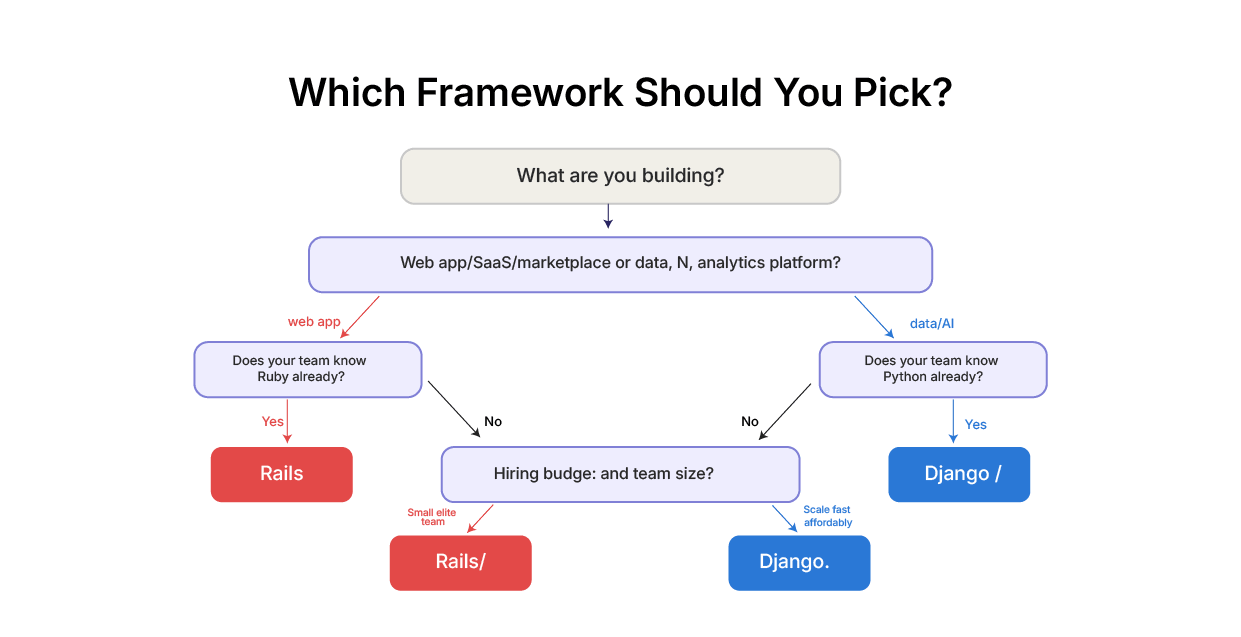
Use this five-step process before committing to either stack:
1. Map your primary workload. Is your core product a web application or a data/AI system?
2. Audit your team's existing language experience. Don't ignore this a team proficient in Python will ship Django faster than Rails, even if Rails is "objectively better" for the use case.
3. Define your hiring budget and timeline. If you need to scale to 10 engineers in six months, Django's talent pool makes that easier.
4. Build a two-day prototype spike using real features from your actual roadmap in your top candidate framework.
5. Decide within two weeks. Delaying the decision is more expensive than choosing imperfectly.
Wrap Up
Ruby on Rails is the right call for consumer web applications, SaaS products, and e-commerce platforms where a tight-knit, senior team needs to move fast. Django wins for data-heavy systems, AI-integrated products, enterprise applications, and any team that needs to scale affordably with a large engineering org.
The Ruby on Rails vs Django debate doesn't have a universal winner. It has a winner for your specific project, team, and timeline and now you have everything you need to find it.
If you're still unsure, the smartest next move is to share your project requirements with a ruby on rails development company or Django-focused partner who builds in both stacks daily. When you hire expert developers through a company such as Amrood Labs that knows both sides of this comparison, you get the right stack recommendation before a single line of code is written.
Table of Content
Share Now
.png)



Learn why parallel Git branches create duplicate migration numbers and how to fix migration conflicts using GitHub Actions. Includes workflow code, testing strategies, and database migration tools.
Six real JWT vulnerabilities, working exploits, and the fixes that stop them. Includes OWASP guidance and a 2026 JWT security checklist for developers.

Learn how to hire Sharetribe developers for on-demand marketplaces. Understand Sharetribe Go vs. Flex, required skills, cost factors, vetting questions, and common mistakes to avoid.

