Custom AI Solutions: Strategy, Development, Deployment & ROI

Custom AI solutions are purpose-built systems designed to solve specific business problems using artificial intelligence. Unlike plug-and-play AI tools, these solutions are architected from the ground up with a company’s unique goals, data, and constraints in mind.
They can be used for multiple purposes, such as predicting sales and automating workflows. The main thing that differentiates it is the interface, including app architecture, data pipelines, and results designed according to the business objective.
This doesn’t just mean writing custom code. To create truly customized AI, you need to prepare in advance for data strategy, infrastructure, and deployment. It takes a diverse group of people working together, including machine learning engineers, data governance experts, UX designers, and those who continually monitor the process.
Off-the-Shelf vs. Custom AI: Key Differences
Off-the-shelf AI tools can be defined as a readymade tool that is developed for general application. They are available in the form of APIs, SaaS platforms, or plug-and-play tools like chatbots, document summarizers, or basic analytics engines. These tools are trained to handle complex data and are developed to be deployed fully with minimal configuration.
Their primary advantage lies in speed and simplicity:
- Fast Time to Value – Businesses can implement functionality within days or weeks.
- Low Entry Cost – Low costs or infrastructural needs up front.
- No In-House AI Expertise Needed – Vendors handle the advanced training, hosting, and updates.
However, this convenience comes at a cost. Off-the-shelf models are built for the average use case, not yours. That means:
- Limited Adaptability – They often fail to capture domain-specific nuances or contextual signals.
- Black-Box Limitations – Many lack transparency or fine-grained control over model logic.
- Shallow Integration – They rarely integrate deeply with internal systems or workflows.
By contrast, custom AI is developed specifically for a business’s unique context. These solutions are built from scratch or fine-tuned using proprietary data, aligned tightly with internal goals and decision processes.
Key characteristics of custom AI include:
- Use of Proprietary or Domain-Specific Data – Enhances accuracy and relevance.
- Process Alignment – Models are trained to follow the company’s internal logic, not generic patterns.
Let's consider two distinct approaches to automating customer support:
- An off-the-shelf chatbot might field basic inquiries using a general-purpose language model trained on internet data.
- A custom AI system could analyze historical support tickets, segment users by account value, and route high-priority issues to live agents, directly improving customer satisfaction and retention.
The downside? Custom AI typically demands more time, resources, and cross-functional collaboration. It involves:
- A longer development timeline
- Integration with existing infrastructure
- Internal alignment between technical and business teams
It is important for enterprises to weigh each tradeoff carefully. Off-the-shelf tools work well for the low stakes, while high-impact AI applications require the advanced-level precision of a personalized solution.
Why Custom AI is Gaining Traction in Enterprise
As AI has started to mature, many enterprises have a question in mind about what generic tools offer. While off-the-shelf solutions may have helped them dip their toes into automation or data-driven decision-making, scaling those efforts securely, effectively, and competitively often demands something more bespoke.
Custom AI offers the depth and alignment needed to create a real strategic advantage.
Key drivers behind the shift:
- Security and Compliance
In regulated industries such as healthcare, finance, or defense, utilizing AI solutions will enable companies to enforce strict data governance, fulfill regulatory requirements, and maintain proper control over data processing. - Legacy Integration
There are many companies that are dependent on the old tech stack. However, custom AI enables them to provide useful features that can help meet the increasing demand.
Still, it’s important to recognize that “custom” doesn’t automatically mean “valuable.” A common pitfall is equating technical sophistication with business impact. Enterprises may invest heavily in building AI solutions that are technically impressive but misaligned with strategic goals or lack the infrastructure and culture to support adoption.
Strategic Use Cases for Custom AI in the Enterprise
Custom AI is rarely pursued by businesses out of curiosity. They make investments when standardized tools are unable to produce a significant commercial impact. Because the operational stakes are too high, the problem is too specialized, or the data is too confidential. All strategic use cases for bespoke AI have one thing in common: they are closely related to quantifiable results like increased income, lower costs, or reduced risk.
Unlike the generic tools that work for every random application, custom AI works specifically to the business goals.
Predictive Analytics for Revenue Growth
One of the main reasons why businesses invest in custom AI is to optimize revenue. They rely on the predictive tools that give them an opportunity to make better decisions.
Custom AI models can forecast:
- Churn risk in subscription-based businesses
- Deal closure probability across enterprise sales pipelines
- Revenue volatility based on usage trends, pricing changes, or seasonality
The advantage lies in data specificity. These systems ingest proprietary inputs such as CRM activity logs, product usage data, customer support history, and NPS scores. As a result, predictions are not just statistically accurate but operationally relevant.
Operational Optimization
Another area where custom AI routinely beats off-the-shelf options is operational efficiency. Constraints, dependencies, and legacy systems are common in enterprise processes that are difficult for generic tools to handle.
Custom AI is commonly applied to:
- Inventory forecasting and demand planning
- Workforce scheduling and capacity management
- Predictive maintenance for equipment and infrastructure
- Logistics and route optimization
These results are not easy to achieve with generic tools as each organization works under the specific conditions. Custom solutions encode those constraints directly into the model logic, ensuring outputs align with real-world decision thresholds.
The measurable impact typically includes lower operating costs, faster turnaround times, and better resource utilization.
Risk Management and Compliance
In regulated industries, AI is often deployed not to accelerate growth, but to reduce exposure. Custom AI plays a critical role where accuracy, auditability, and compliance are non-negotiable.
Common applications include:
- Fraud detection in financial services
- Compliance monitoring in healthcare and insurance
- Risk scoring for credit, underwriting, or claims processing
These tools are tailored to meet specific business requirements that generic tools cannot. For example, a finance company has developed a custom fraud detection application that incorporates its own transaction flows, threat actors, and company profile, rather than relying on assumptions based on the company's own data.
Custom AI also enables greater transparency and explainability, which is becoming increasingly important for regulatory scrutiny. Enterprises can document how decisions are made, retrain models when policies change, and enforce strict governance controls over sensitive data.
Here, the value is defensive but substantial: fewer losses, faster audits, and lower regulatory risk.
Vertical-Specific Scenarios
Some AI use cases are inherently industry-specific, making customization essential rather than optional. Data structures, decision logic, and success metrics vary widely across sectors, and applying generic AI often leads to a poor fit or limited adoption.
Examples include:
- Medtech: Diagnostic imaging models trained on institution-specific datasets to improve accuracy and reduce false positives.
- Insurance: Claims automation systems that learn from historical fraud patterns and regional risk factors.
- Real Estate: Property valuation engines that incorporate hyperlocal market data, zoning rules, and transaction history.
In these contexts, overgeneralized AI can produce misleading outputs or require extensive manual correction. Custom AI, by contrast, reflects the operational reality of the industry and delivers insights decision-makers can trust.
The strategic takeaway is clear: enterprises gain the most value from AI when it mirrors the nuances of their domain rather than abstracting them away.
The End-to-End Lifecycle of Custom AI Development
Building an AI system isn’t just about writing code and hoping it works. It's a structured, step-by-step process that takes planning, teamwork, and ongoing care. This full journey, from idea to working product, is what we call the lifecycle of custom AI development.
Let’s break it down in simple terms.
Step 1: Strategic Alignment and Feasibility
Before anything is built, teams need to get on the same page. This means answering big questions like:
- What problem are we trying to solve?
- Why does it matter for the business?
- Do we have the data and tools to support this project?
At this stage, people from different departments, IT, business, data teams, need to align their goals. If they don’t agree early on, the project can go off track later. That leads to wasted money and confusion. It’s like starting a construction project without knowing what kind of building you’re making.
Step 2: Data Collection and Preparation
Good data is the heart of any AI system. But in most companies, data isn’t just sitting around, perfectly clean and ready to use. It’s messy, scattered, or incomplete.
This step can take weeks or even months, and involves:
- Fixing missing or incorrect information
- Combining data from different systems
- Labeling and organizing the data correctly
- Adding useful outside data if needed
Skipping this part or rushing through it almost always leads to poor AI performance. Imagine trying to bake a cake with expired ingredients, it won’t turn out well, no matter how good the recipe is.
Step 3: Model Selection and Training
Now it’s time to build the "brain" of the AI. This is the model that learns patterns from the data and makes predictions or decisions.
There are different types of models for different tasks. Some are simple and fast; others are complex and powerful. The team has to pick what fits best for the goal.
Then comes training. This means feeding the model lots of examples so it can learn. During this process, the team tweaks different settings (called hyperparameters) and checks to see how well the model is doing.
Think of it like teaching a student: you try different teaching styles and keep testing them until they start getting the right answers.
Step 4: Validation and Testing
Before putting the model into the real world, you have to make sure it’s ready. That means testing it in many ways:
- Does it work consistently on different types of data?
- Can it handle unusual or rare situations?
- Is it fair and unbiased?
Skipping proper testing can lead to major issues later, like wrong predictions, unfair treatment of users, or even legal trouble. This step helps build trust in the system before anyone uses it in real decision-making.
Step 5: Deployment and Monitoring
Once testing is complete, the model gets deployed, meaning it’s put into the company’s actual systems where it can do its job.
But deployment isn’t the end of the road. In fact, it’s just the start of a new phase: monitoring.
After launch, teams need to:
- Watch for drops in model accuracy (called drift)
- Make sure the incoming data stays clean
- Track performance, speed, and uptime
Without ongoing monitoring, even the best model can fall apart over time. Business needs change. Customer behavior changes. And so must the AI.
When done right, custom AI development leads to systems that truly support real business goals not just flashy demos.
Deployment Models for AI Solutions
Once an AI model is ready, it needs somewhere to live and run. That “somewhere” is called the deployment environment. Choosing the right one depends on how the business operates, what kind of data is involved, and how fast decisions need to be made.
Here are the main options for deploying enterprise AI solutions, and the tradeoffs to think about.
Option 1: Cloud-Based Deployment
This is the most common setup, especially for teams that want to move fast. Companies use platforms like Amazon Web Services (AWS), Microsoft Azure, or Google Cloud to host and run their AI models.
Benefits of cloud deployment:
- Easy to scale up or down as needed
- No need to manage physical servers
- Fast to set up and test ideas
Cloud works great for data-heavy models or when companies don’t have in-house tech infrastructure.
But the cloud isn’t always perfect:
- It may be slower for real-time needs
- Sensitive data may face privacy or compliance issues
- Monthly costs can grow fast with scale
Still, for most modern enterprise AI solutions, the cloud offers a flexible starting point.
Option 2: On-Premise Deployment (For High-Security Needs)
In industries like healthcare, banking, or defense, privacy and control are everything. For these cases, companies often run AI models on their own internal servers, called on-premise deployment.
Why choose on-prem?
- More control over data security
- Custom rules for who can access what
- Easier to meet strict compliance standards
The tradeoff? It takes longer to set up and costs more up front. You’ll need physical hardware, specialized IT staff, and security protocols. But when protecting sensitive data is a must, on-premise is often the right call.
Option 3: Edge and Hybrid AI Architectures
Sometimes, decisions have to be made instantly, like detecting defects on a factory line or spotting unusual behavior in a smart camera system. In these situations, waiting for the cloud to respond isn’t fast enough.
This is where edge AI comes in. It runs directly on devices (like machines or sensors), not in the cloud.
Benefits:
- Super low latency (no delays)
- Works without internet access
- Ideal for manufacturing, logistics, and IoT
Hybrid AI combines the best of both worlds. It runs parts of the model on local devices, while syncing with cloud systems for updates and deeper analysis.
Choosing the right deployment depends on:
- How quickly decisions need to be made
- Whether data needs to stay private or local
- What infrastructure is already in place
Trying to force everything into the cloud, especially in low-latency use cases, can backfire. A thoughtful deployment strategy is essential for maximizing the value of enterprise AI solutions.
Measuring ROI of Custom AI Solutions
When enterprises invest in AI, it’s not just about building something impressive, it’s about delivering measurable value. Return on investment (ROI) is the yardstick that determines whether AI-powered product development is a strategic asset or just another sunk cost.
Understanding the full picture of cost and impact is critical for making informed decisions and earning long-term stakeholder support.
Cost Breakdown: Build, Integrate, Maintain
Calculating ROI starts with understanding what you’re actually spending. Costs extend far beyond the initial build phase.
Here’s what the total cost of ownership (TCO) typically includes:
- Data Acquisition & Cleaning – Collecting, formatting, and labeling data can take weeks or months, especially in regulated environments.
- Model Development & Retraining – Initial training is resource-intensive, but ongoing updates are equally essential as data and business needs evolve.
- Infrastructure – Whether you're using cloud platforms or on-premise servers, compute power and storage have recurring costs.
- Integration & Support – Models must connect with existing systems, which means APIs, user interfaces, and technical support pipelines need to be in place.
- Monitoring & Maintenance – AI doesn’t run itself. Ongoing performance tracking and drift detection are needed to keep results reliable.
Ignoring these full-lifecycle costs can lead to unrealistic ROI expectations. Too many AI initiatives fail not because the model didn’t work, but because the long-term costs were underestimated.
Quantifying Efficiency and Revenue Uplift
Once the investment is clear, the next step is to measure outcomes, not just whether the model is "accurate," but whether it creates real business impact.
Key ROI levers include:
1. Time Saved – Automating manual processes like customer support, document review, or lead scoring can reduce labor hours dramatically.
2. Fewer Errors – AI systems can standardize decision-making and reduce human mistakes, especially in repetitive tasks.
3. Revenue Gains – Smarter targeting, churn prediction, and dynamic pricing can boost top-line performance.
For example, imagine an enterprise support team using AI to auto-categorize and triage tickets. If response times drop by 30%, that translates into higher customer satisfaction and lower churn a meaningful business outcome.
Crucially, ROI should be tracked after deployment, not just modeled in theory. This is where enterprise AI solutions differ from experimental AI labs, they’re built for impact, not novelty.
Common ROI Benchmarks by Industry
ROI benchmarks vary widely across sectors, and comparing apples to oranges can be misleading. The best practice is to benchmark against your own key performance indicators (KPIs), but general trends help set expectations:
- Fintech: ROI often comes from fraud reduction, risk scoring accuracy, and compliance automation.
- SaaS: Reducing churn, upselling to high-LTV customers, and optimizing onboarding journeys are common metrics.
- Manufacturing: AI-driven preventive maintenance and quality control reduce downtime and product defects.
One common mistake: calculating ROI only based on development spend. A successful custom AI development initiative must include rollout costs, internal training, support overhead, and opportunity costs.
Buy vs. Build: Should You Invest in Custom AI?
Every enterprise eventually faces a key question: Should we build our own AI system or use an existing platform? There’s no one-size-fits-all answer, but there are clear tradeoffs between out-of-the-box platforms and custom AI development.
Custom vs. Platform Tools
Off-the-shelf platforms like Azure OpenAI, Amazon Bedrock, or Google Vertex AI offer speed and accessibility. They’re ideal for simple use cases, early-stage experimentation, or teams with limited AI maturity.
Custom AI, on the other hand, is built specifically for your business logic, workflows, and data. It’s more resource-intensive, but also more powerful.
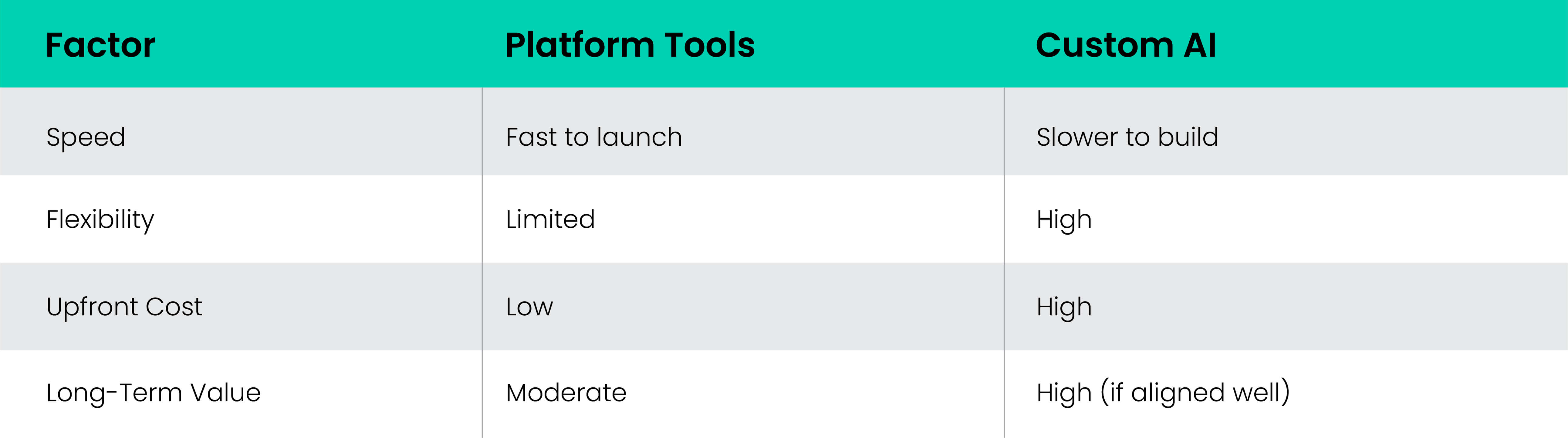
Custom AI wins when the problem is critical, the workflows are complex, or the data is proprietary. Platform tools are best for low-stakes or short-term needs.
When to Start with Off-the-Shelf
Early-stage teams or new initiatives often start with pre-built tools to prove a concept. For example:
- Using ChatGPT to handle basic customer queries
- Automating document summaries with Azure AI
These tools help identify what works before you commit significant resources to building your own system. Once value is proven, many organizations graduate to custom builds for scale and precision.
Decision Framework: 5 Key Criteria
To decide whether to build or buy, use this quick checklist:
- Business Criticality – Is this use case directly tied to revenue, risk, or compliance?
- Data Uniqueness – Do you have internal data that could improve model performance?
- Compliance Needs – Are there legal or ethical limits on where or how data can be processed?
- Integration Depth – Does the system need to work inside existing tools like CRMs, ERPs, or ticketing systems?
- Internal Maturity – Does your team have the skills and support structure to maintain AI systems over time?
If you check yes on at least three of these, enterprise AI solutions built custom may be worth the investment.
Risk Factors & Challenges in Custom AI Projects
AI can unlock real business value, but it’s not without risk. Missteps in strategy, design, or governance can quickly turn a promising project into a costly failure. Understanding the challenges ahead of time helps reduce surprises.
Data Privacy and Governance
Just because you have access to data doesn’t mean it’s usable. Data must be managed responsibly, especially in regulated sectors like healthcare, finance, and education.
Key concerns include:
- Consent and Usage Rights – Are users aware that their data is being used for AI?
- Anonymization – Sensitive data must be protected, especially in model training.
- Audit Trails – Enterprises need logs showing who accessed what data and why.
Poor data governance exposes businesses to legal risk and public backlash. For AI to work long-term, privacy must be baked into the foundation.
Talent Requirements and Hiring
AI isn’t built by one person. Effective custom AI development requires a cross-functional team, including:
- Machine learning engineers
- Data pipeline and backend developers
- DevOps or MLOps specialists
- Domain experts who understand the business problem
Hiring and retaining these specialists is a challenge, especially as demand outpaces supply. Without the right team, even the best tools can fall flat.
Model Drift and Maintenance
AI models don’t stay “smart” forever. Over time, the world changes, customer behavior shifts, markets evolve, and data pipelines degrade.
This is called model drift, and it can break even well-trained systems.
Common causes include:
- New customer segments
- Software updates that change data formats
- Seasonal shifts in behavior or demand
To stay accurate, models need monitoring, retraining, and sometimes even re-designing. Without this, trust in the system erodes, and usage declines.
Regulatory and Ethical Concerns
Laws around AI are evolving fast, especially in Europe and North America. Companies must prepare for scrutiny around:
- Bias and Fairness – Is the model treating different groups fairly?
- Explainability – Can you clearly explain how the AI makes decisions?
- Accountability – Who is responsible when the model gets it wrong?
Lack of transparency is one of the biggest blockers to deployment, especially in sensitive industries like healthcare, finance, and government.
Failing to address these concerns doesn’t just invite compliance issues, it can stop adoption cold.
Conclusion
AI programs succeed when leaders treat them as operating systems for decisions, not one-off experiments. If you want durable outcomes, you need a clear use case tied to a measurable KPI, data access you can defend, architecture that fits your latency and compliance needs, and an operating plan that accounts for drift, failures, and ongoing cost.
That approach also keeps procurement and stakeholder conversations grounded. Instead of debating model types in isolation, you can compare options based on integration complexity, control, risk, and the economics of running the system over time. When you do this well, ROI becomes a byproduct of disciplined execution: you define the intervention, instrument the workflow, and measure impact with a baseline and a rollout plan.
If you’re evaluating next steps and want a consultation that stress-tests feasibility, deployment constraints, and ROI assumptions, contact Amrood Labs.
Table of Content
Share Now
.png)