




A customer tries to pay for a flight. Their card gets declined. Meanwhile, a fraudster using stolen account details slips through another platform’s checks. Both cases expose the same problem: banks need better ways to judge risk. Those checks should keep everyday banking simple.
In 2025, Americans reported losing $15.9 billion to fraud, up from $12 billion the year before, according to the FTC. And that only counts the people who reported it.
The attackers have new tools, too. Deepfakes now show up in about 1 in 100 failed identity checks, says LexisNexis Risk Solutions. That number rose 180% in a single year. AI in fintech can help by finding signs of risk, checking proof of identity, and cutting routine review work. Its value depends on how well those tools fit the choices people need to make.
This article explains how AI fraud detection, KYC automation, and compliance workflows connect. It covers research and common risks.
What is AI in Fintech?
AI in fintech uses tools such as machine learning to support banks and payment firms. These tools can assess payment risk and read details from IDs. They also help staff review cases. People set the controls and check results. They remain in charge of how the system is used.
Three related functions matter here:
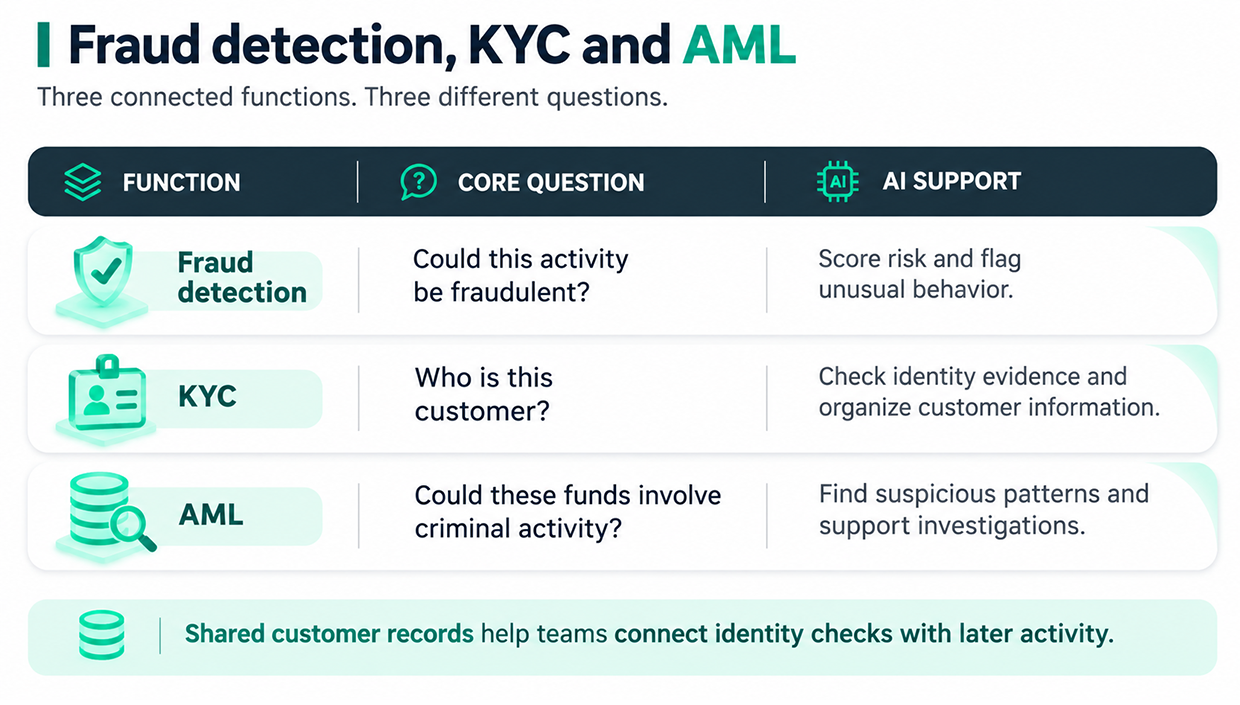
Linking these tasks gives teams a fuller picture. An ID check may look sound on its own. Yet later payments can raise concerns that deserve another look.
How Does AI Fraud Detection in Fintech Work?
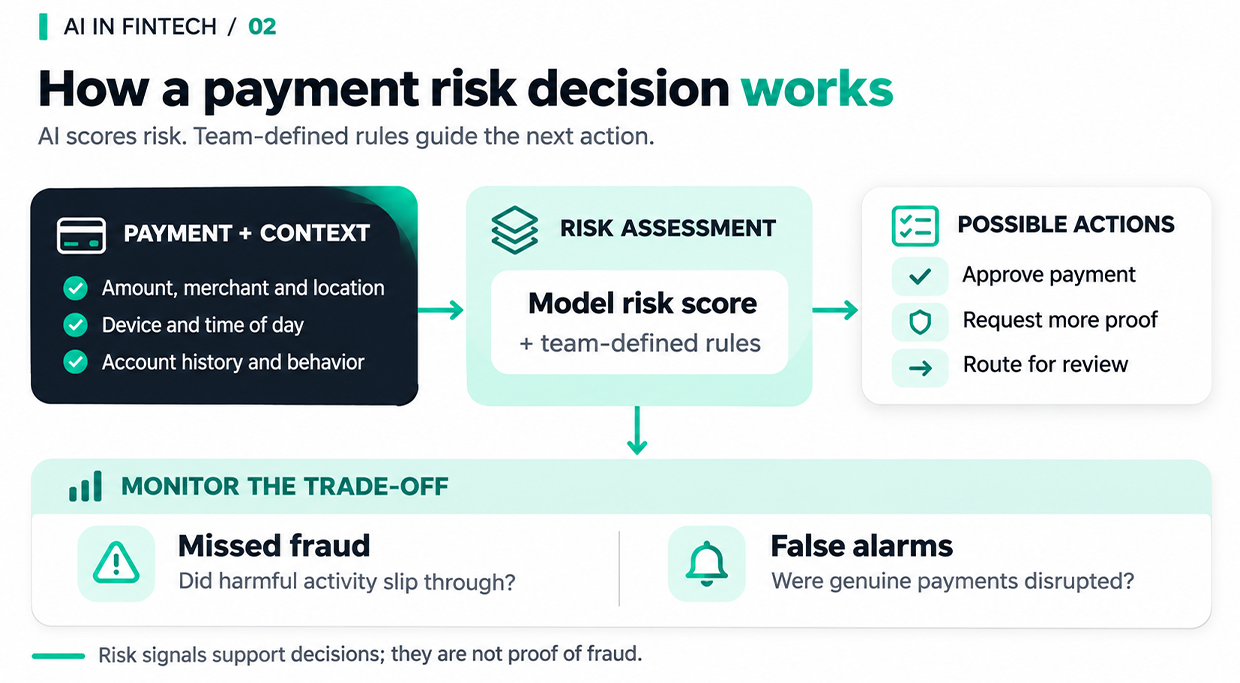
AI fraud detection in fintech uses payment details, account history, device signals, and behavior to score risk. The system then uses that score alongside rules set by the team. It may approve a payment, request more proof, or send a case for review.
Credit Card Fraud Detection in Real Time
Credit card fraud detection is where AI first proved itself. Card payments were the most common payment method named in FTC fraud reports for 2025. Every swipe or tap gives the model fresh data: amount, merchant, location, device and time of day.
Say a customer in Lahore usually buys groceries and fuel. Suddenly their card buys three gaming gift cards online at 3 a.m. from a new device. A rule might miss it if each amount is small. A model sees the whole pattern and stops the payment before it goes through.
What the Results Look Like
The big card networks show what is possible at scale:
- Visa has invested about $13 billion in AI and technology over five years. It now runs more than 300 AI models across fraud prevention, cybersecurity and operations.
- Mastercard's 2025 fraud prevention research found that 42% of card issuers and 26% of acquirers saved more than $5 million in fraud attempts over two years thanks to AI.
- In the same research, 83% of industry leaders said AI had cut false positives and customer churn.
You don't need Visa's budget to get these gains. Cloud tools and open-source libraries now let a mid-sized fintech build models that would have needed a research lab ten years ago.
How Fraud Detection Machine Learning Models Find Risk
For fraud detection, machine learning can learn from examples of past fraud and genuine activity. Other methods flag unusual behavior or examine links between accounts, devices, and payments.
These approaches can support several tasks:
- Spotting account takeover after unusual login or payment activity.
- Finding groups of accounts that share links worth checking.
- Ranking alerts so staff can review urgent cases first.
- Finding patterns that fixed rules may miss.
Rules still have a role. Clear limits and known warning signs can work alongside models. Teams should test both together and monitor missed fraud as carefully as false alarms.
How AI KYC Verification Improves Customer Onboarding
AI KYC verification helps teams process identity documents, compare information, and route uncertain cases for review. A well-designed workflow reduces repeated data entry while giving reviewers access to the evidence behind each result.
From Document Upload to Identity Checks
During onboarding, a customer may submit an identity document and complete a face or liveness check. Optical character recognition extracts text, while other tools check document features and compare the details.
Reading a name from a passport does not prove that it is real. A face match still leaves other questions about the customer’s risk.
The Financial Action Task Force’s digital identity guidance stresses the need to assess a system’s assurance levels, reliability, and independence. Its guidance is technology-neutral; adding AI alone does not establish suitability for customer due diligence.
Faster Checks Need Strong Exception Handling
KYC automation should make the next step clear when a check fails. A blurred image might call for a new upload. Details that do not match may need a trained reviewer.
This distinction matters as attackers gain better tools. In November 2024, FinCEN warned about suspicious activity involving deep fake media, including fraudulent identity documents used to bypass verification and authentication.
Teams should test their checks against known threats. They should also offer a clear review path for genuine customers.
KYC Continues After Account Opening
KYC and compliance work extends beyond the first upload. Customer details can change. Later payments may differ from the account’s expected use.
A useful design links the first ID checks with later risk reviews and updates.
How AML Compliance Automation Supports Investigations
AML compliance automation helps teams monitor activity, organize alerts, and prepare evidence for review. The aim is to help staff spend less time gathering records. That leaves more time to assess what those records mean.
Find Connections Across Payments
A single transfer may look routine. A chain of transfers across linked accounts can tell a different story. Network analysis looks at those links. It gives teams a view that goes beyond each payment on its own.
The BIS Innovation Hub explored this approach in Project Aurora. Its 2023 proof of concept used synthetic payment data to test machine learning, network analysis, and privacy-enhancing technologies. Collaborative analysis performed better at detecting laundering networks than analysis conducted in isolation.
The study shows potential, rather than guaranteed production results. Live systems still need good data and lawful ways to share it. They also need controls that fit their use.
One Customer, Several Connected Checks
Imagine a digital wallet customer who passes identity checks and begins making small payments. Weeks later, the account gets funds from many new senders. It then quickly moves the money elsewhere.
This hypothetical example does not prove money laundering. It gives the team a reason to look closer. Staff can compare the payments with the customer’s stated purpose and other records.
A shared workflow brings the ID checks, payment timeline, and past reviews into one case. A reviewer can then ask for more details or record a sound reason for the payments. They may also raise the concern through the agreed process.
That shared view helps fraud and compliance teams avoid repeating the same research.
Reduce the Work Behind Each Alert
KYC AML compliance brings customer checks and money-laundering controls into a wider risk process. AI can help collect account histories, highlight changes, and arrange supporting documents for investigators.
Generative AI can also draft case summaries. Those drafts should link back to source records. Reviewers need to check names, dates, amounts, and conclusions before relying on them.
Amrood Labs’ guide to AI-assisted financial document review explores how document workflows can combine extraction, classification, and summaries. Test each task on its own. The risks of error differ for each one.
What Responsible AI Compliance in Banking Requires
AI compliance in banking needs clear roles, evidence, and controls. Teams should be able to explain what a tool does. They need to know where it can fail and who handles those cases.
- Can reviewers understand the result? Show the source records and reasons for review.
- Is customer data protected? Limit access, secure transfers, and set rules for how long data is kept.
- Does performance vary across users? Test document types, languages, and customer groups.
- Can staff intervene? Give staff ways to review results and change them. Record why they made each change.
Generative tools need extra care. A clear, fluent summary can still contain made-up details. Keep source records available and limit what the tool can change without approval.
For a broader implementation view, Amrood Labs explains AI governance controls that connect policies with roles, data access, and review steps.
How to Build These Capabilities into a Fintech App
Good fintech app development starts with a clear problem. A team with slow ID checks may want to start there. A team with too many fraud alerts needs a different first project.
1. Choose One Workflow and Set a Baseline
Pick one task, such as reading ID fields or ranking alerts. Record current review time, error rates, and workload before making changes. Agree on the results you need before a wider rollout.
2. Check Data Quality and Access
Check which records you have and how past results are labeled. Make sure the data reflects current users. Missing fields and mixed labels can weaken an early trial.
The Amrood Labs guide to data requirements for custom AI provides a useful starting point for assessing readiness.
3. Plan Integration and Failure Handling
Link the chosen tool to account records, payment systems, and review queues. Decide what happens if a provider is slow or goes offline. Customers and staff need a workable next step when automation fails.
These choices belong in the wider architecture. The financial application scaling challenges covers related concerns around integrations, security, and testing.
4. Test Before Expanding
Run the tool alongside the existing process before allowing it to affect live decisions. Compare results and look into cases where the systems disagree. Check how much extra review work the tool creates.
After release, monitor changing behavior and model performance. New data does not always make a system better. Test updates before use.
How to Measure Business Value
AI fraud detection should earn its place through measurable results. Track a balanced set of results. One strong score can hide other problems.
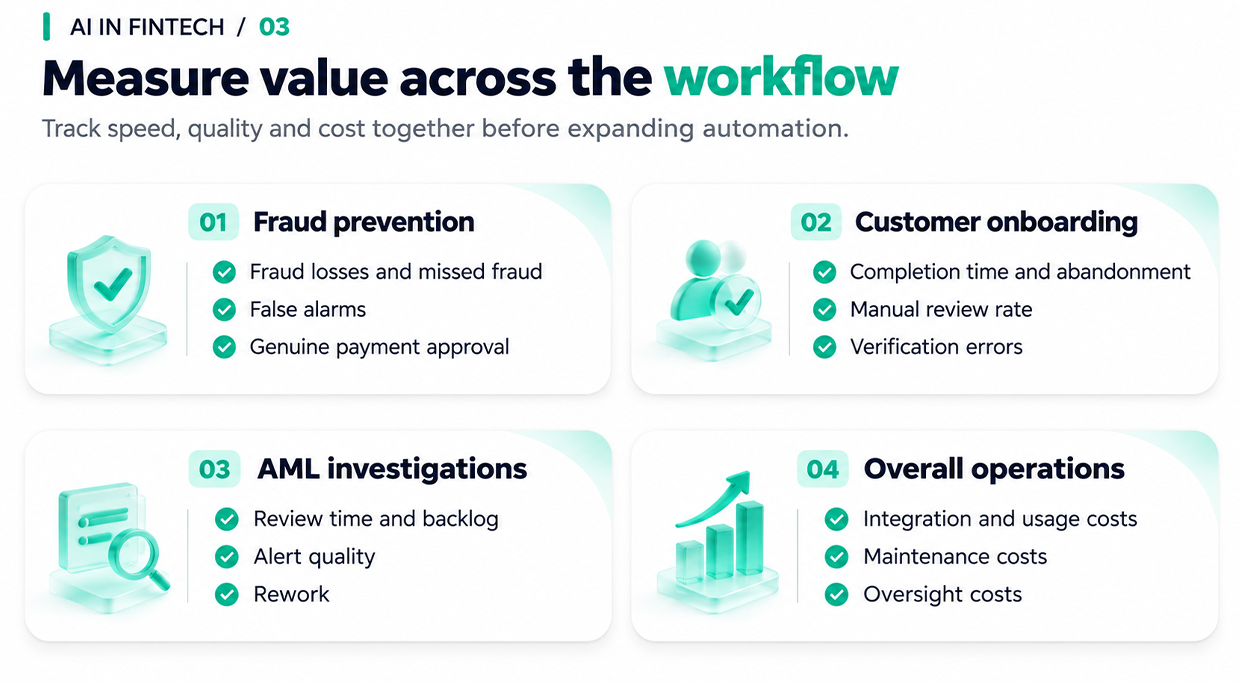
For example, faster onboarding offers limited value if more genuine customers fail verification. Similarly, fewer alerts are only useful if important suspicious activity still reaches investigators.
Compare results over the same length of time. Account for changes in payment volume or customer mix. Use those findings to decide whether to expand, change, or stop the trial.
Final Thoughts
AI is now on both sides of the fight. Criminals use it to fake faces and test stolen cards at scale. The fintechs that win use it to stop them faster, with fewer false alarms and a smoother experience for real customers.
You don't need to rebuild everything at once. Start with the area that hurts most, whether that's card fraud, slow onboarding or a flood of AML alerts. Prove the value, then expand.
Amrood Labs helps fintechs build secure, compliant products with AI at the core. Our fintech app development work covers everything from mobile apps to custom fraud models and AI automation. Book a free consultation to talk through your fraud and compliance goals.
Frequently Asked Questions
Can AI replace fraud analysts and compliance teams?
AI can handle parts of data review, alert sorting, and reading documents. People still need to assess complex cases and challenge outputs. They also manage the controls around the system. The right split depends on the task and its risks.
What is the difference between KYC and AML?
KYC focuses on understanding customers and checking their identities. AML covers the wider effort to detect and prevent money laundering. Customer information from KYC helps teams interpret transactions and investigate suspicious activity.
Does AI eliminate false positives?
No. AI can help reduce false positives. Results depend on data quality, risk thresholds, and changing behavior. Teams should measure both false alerts and missed fraud when checking results.
Should a fintech build or buy its AI tools?
Start by comparing data needs, setup work, control, and ongoing cost. A specialist vendor may suit a standard verification task. A custom tool may fit a workflow that needs close links with other systems or unique data. Test each option against the same goals.