Why Ed-Tech Platforms Struggle With Scalability and User Engagement
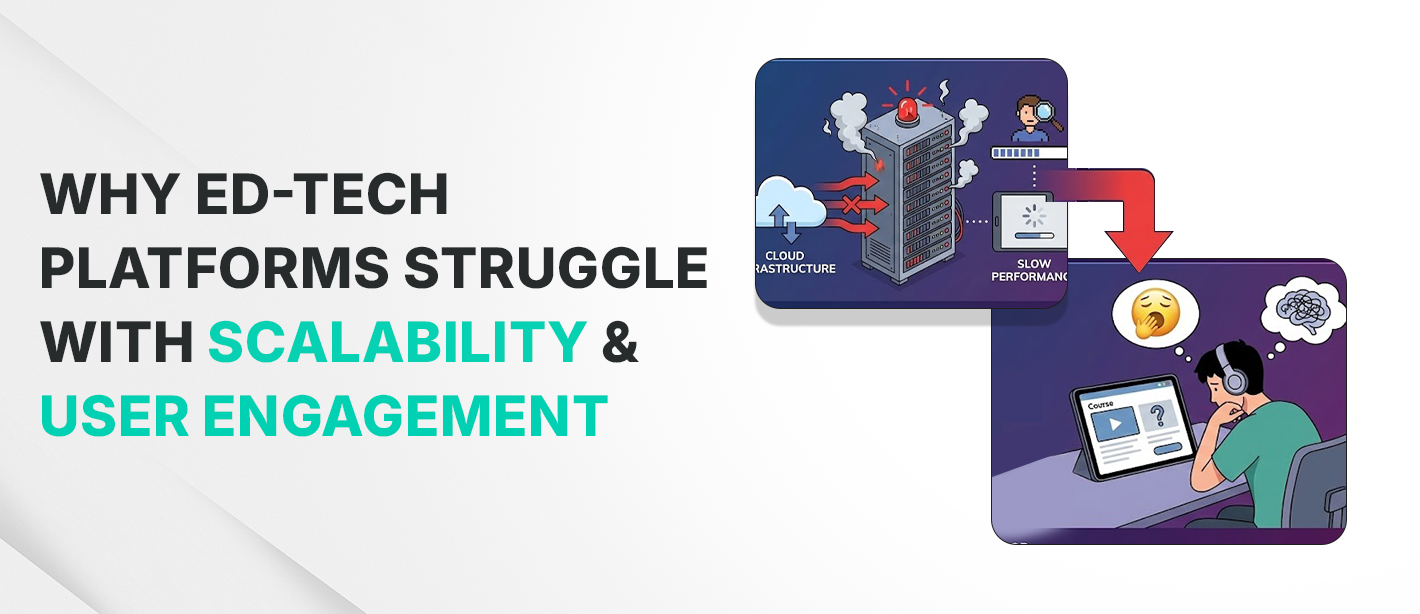

Although ed-tech has revolutionized education, one of its disadvantages is that, even with advanced improvements, the platform still reaches a scaling barrier. When demand increases, a platform that starts out promising with captivating content, a smooth user experience, and encouraging learner feedback often fails. The question is why?
The root issues go beyond technology. They reflect a deep mismatch between product ambition and market reality. From cultural misalignment and poor backend planning to the mismatch between buyer and user incentives, Ed-Tech platforms face an uphill battle.
The structural, behavioral, and technical causes of Ed-Tech platforms' inability to grow or sustain user engagement will be examined in this article, along with potential solutions. This is your road map for long-term success, regardless of whether you're working with a web application development business or creating your own learning solution.
The Cultural Friction of Global Education
One of the most overlooked barriers to scalability is geography, not in terms of infrastructure, but in user behavior. Education is not a universal language. Local customs, curricula, and institutional systems deeply shape it. A platform that is famous in the USA might have some limitations in finding resources in Africa or in other countries.
For instance, interactive peer-based learning might be normal in Western culture, but it gives an awkward feeling in cultures rooted in teacher-centered instruction.
So while a web development company might build a technically scalable product, localization is more than translation. It requires rethinking user flows, content delivery, pricing models, and even UX copy. This constant reengineering hinders rapid expansion, especially for startups with limited resources.
In education, there’s no “one-size-fits-all.” Each market demands its own version of the product, making global scale a long, costly journey rather than a simple code deployment.
Engagement vs. Compliance: The Buyer-User Gap
In Ed-Tech, the person paying for the product is rarely the same as the one using it. Schools, government organizations, or business HR departments usually pay for the platform, but teachers, students, or employees actually use it.
This creates a classic engagement dilemma. Product decisions cater to administrators' reporting needs or budget constraints, not to user experience. As a result, platforms may be packed with compliance features but offer little actual learning value. Students log in, complete tasks out of obligation, and churn shortly after.
To bridge this, custom platforms must strike a balance. When partnering with a custom web application development company, ensure they understand this split dynamic. Systems must support reporting for stakeholders while genuinely engaging learners through intuitive design, interactivity, and timely feedback. Failing to satisfy both sides is a fast track to abandonment, even if the product is technically “working.”
The Scalability Illusion: Can Your Stack Grow With You?
Many EdTech products start as a single-region solution with predictable traffic. Then growth happens, sometimes seasonally (enrollment spikes), sometimes suddenly (a district rollout). But when usage grows, say, from 1,000 to 100,000 learners, performance bottlenecks and security flaws begin to surface.
Scalability isn’t just about handling more users. It’s about doing so without compromising load speed, data integrity, or feature performance. Without robust backend development services, platforms risk slow load times during peak hours, broken media uploads, or even data loss.
This is where the right partner matters. A seasoned web application development company will build your stack with microservices, cloud-native architecture, and CDN distribution to support growth without technical debt. Too many Ed-Tech startups burn out not because they lacked users, but because they couldn’t keep up with them.
The Engagement Cliff: Why Users Drop Off Fast
A platform can feel smooth and still fail educationally. EdTech often confuses activity with learning: clicks, streaks, badges, and time-on-platform can look strong while outcomes stay flat. Learners may return for dopamine loops without building durable skills, or they may disengage because the experience never creates real momentum.
The engagement problem usually shows up in three places:
- Relevance: learners don’t see how the content connects to their goals
- Friction: too many steps between intent (“I need to learn X”) and action
- Feedback: users don’t get timely, meaningful signals that they improved
You can’t solve these with gamification alone. You solve them with better learning loops: short tasks, clear objectives, immediate feedback, and structured review. The platform should make progress visible and credible, not merely “fun.”
This is why product teams need tight collaboration between pedagogy, UX, and engineering. When you approach the build as custom web development, you can shape the experience around specific cohorts (K-12, higher ed, workforce learning) rather than forcing one generic flow.
Execution detail matters: sequencing logic, prerequisites, remediation paths, and pacing controls are not “nice to have” if you want retention that survives beyond the first week.
Infrastructure That Cracks Under Pressure
Another overlooked issue in scaling Ed-Tech is infrastructure readiness. Most founders focus on the front end what learners see but ignore how the system behaves when it matters most.
The adoption blockers are consistent:
- Course setup takes too long
- Content creation tools don’t match how teachers plan
- Grading and feedback workflows feel slow
- Classroom management features don’t fit real routines
- Training materials assume high digital comfort
This is not about “more features.” It is about removing work. Teachers need automation where it helps and control where it matters. Admins need oversight without forcing complexity onto instructors.
Let’s say a university launches a nationwide course and thousands of users log in within minutes. If your hosting setup isn’t elastic via AWS, Azure, or GCP, latency spikes, pages crash, and learners drop out.
This is where custom web development services play their essential role. Unlike off-the-shelf solutions, custom platforms allow for load balancing and serverless functions, all of which are essential for seamless performance during traffic surges.
A web app development company experienced in education workflows will prioritize this foundation from day one. Otherwise, growth becomes your biggest liability.
Business Models That Don't Support Scale
Selling education is hard. Unlike media or retail, education feels like a need but behaves like a hard sell. People want the benefit but often resist the process or the cost. Platforms that charge upfront struggle with acquisition. Ad-supported models can’t sustain quality content. Institutional sales involve slow cycles and endless bureaucracy.
Without a stable business, even a developer app with advanced features won't survive for long. This is where flexibility from your custom web application development company can help. For instance, integrating tiered pricing or B2B licensing requires a backend architecture that supports multiple user flows and payment gateways.
Don’t just build for learners. Build for how you'll make money from them or risk building the most elegant failur e on the internet.
Edutainment Is Not Enough
Some Ed-Tech platforms scale impressively by turning education into entertainment. Duolingo’s gamified language app is a case in point. But here’s the catch: engagement metrics like logins or session duration don’t always translate into learning outcomes.
In other words, your platform might be sticky but shallow.
Better metrics tie behavior to progress:
- Completion rates by module (not just course-level)
- Time-to-first-success (how quickly users achieve a meaningful win)
- Drop-off points tied to specific screens or tasks
- Learning outcomes or skill evidence (even lightweight signals)
- Cohort retention by role (teacher vs learner vs admin)
When you instrument the product correctly, you can run improvements that actually help: simplify a workflow, adjust pacing, refine feedback, reduce load times, and improve accessibility.
Implementing this well requires a deliberate analytics architecture and clean event taxonomy work that is often underfunded because it is invisible in marketing. Yet it is decisive for both engagement and scale.
Teams that treat this as web application development company-level engineering work (not a quick plugin) build durable learning intelligence into the platform. And when you work with web app development companies that understand product analytics, you get cleaner data and faster iteration cycles, which reduces the odds of “building the wrong thing” for months.
Scaling Without Losing Sight of Quality
Quality control turns into a quiet killer at scale. Bugs are overlooked. Content becomes stale. Users encounter erratic user interfaces or broken connections, particularly when several teams are distributing updates to various geographical areas.
For this reason, modular development, robust DevOps solutions, and QA testing are essential. Working with web app development firms that incorporate version control, CI/CD pipelines, and automated testing guarantees that scaling won't impair user experience.
Ed-Tech is not a one-time project. It's an active platform. The unseen processes operating in the background are frequently the deciding factor between startups that fail and those that succeed.
To guarantee long-term support rather than just a launch-day victory, when in doubt, outsource web development with maintenance contracts.
Final Thoughts
Ed-Tech isn’t broken. However, compared to other IT products, the path to scale is different. Success involves more than just creating a beautiful user interface or releasing a mobile application; it also calls for market realities, structural preparedness, and a thorough comprehension of user psychology.
Your choice of web application development business is as important as your product vision if you're thinking about creating or improving your Ed-Tech product. Seek partners who are not simply familiar with programming but also with the subtleties of education, engagement, and infrastructure.
At Amrood Labs, we work with education leaders to design platforms that don’t just launch last. From custom web development and ecommerce web development to long-term scaling solutions, we help Ed-Tech platforms become resilient, reliable, and ready for what's next.
Because in education, scaling isn't just about growth. It's about impact and that takes more than tech.
Frequently Asked Questions (FAQs)
Why do so many Ed-Tech startups fail to scale?
Because they won't be able to understand the complexity in the education market, their difference in cultural aspects, regulatory demands, and the buyer-user mismatch all create friction.
How important is UX in user engagement for Ed-Tech?
Critical. A seamless, feedback-rich UX keeps learners motivated. Poor navigation or static content quickly leads to drop-off.
What technical foundations support scalable Ed-Tech platforms?
Cloud hosting, modular microservices, elastic load balancing, and robust backend development services are essential to handle growth without downtime.
What role does a custom development partner play?
A custom web application development company brings tailored architecture, feature integration, and strategic support that generic platforms can't offer especially at scale.
Can outsourcing web development work for long-term scalability?
Absolutely if you work with a team that understands Ed-Tech’s unique blend of pedagogy, product, and performance. Long-term support is as important as initial development.
Table of Content
Share Now
.png)