

.png)
.png)



A developer can choose a tech stack and programming languages based on your application goals and your team's strengths. The decision depends on the database, web server, server-side tools, and frontend framework that form the application's foundation.
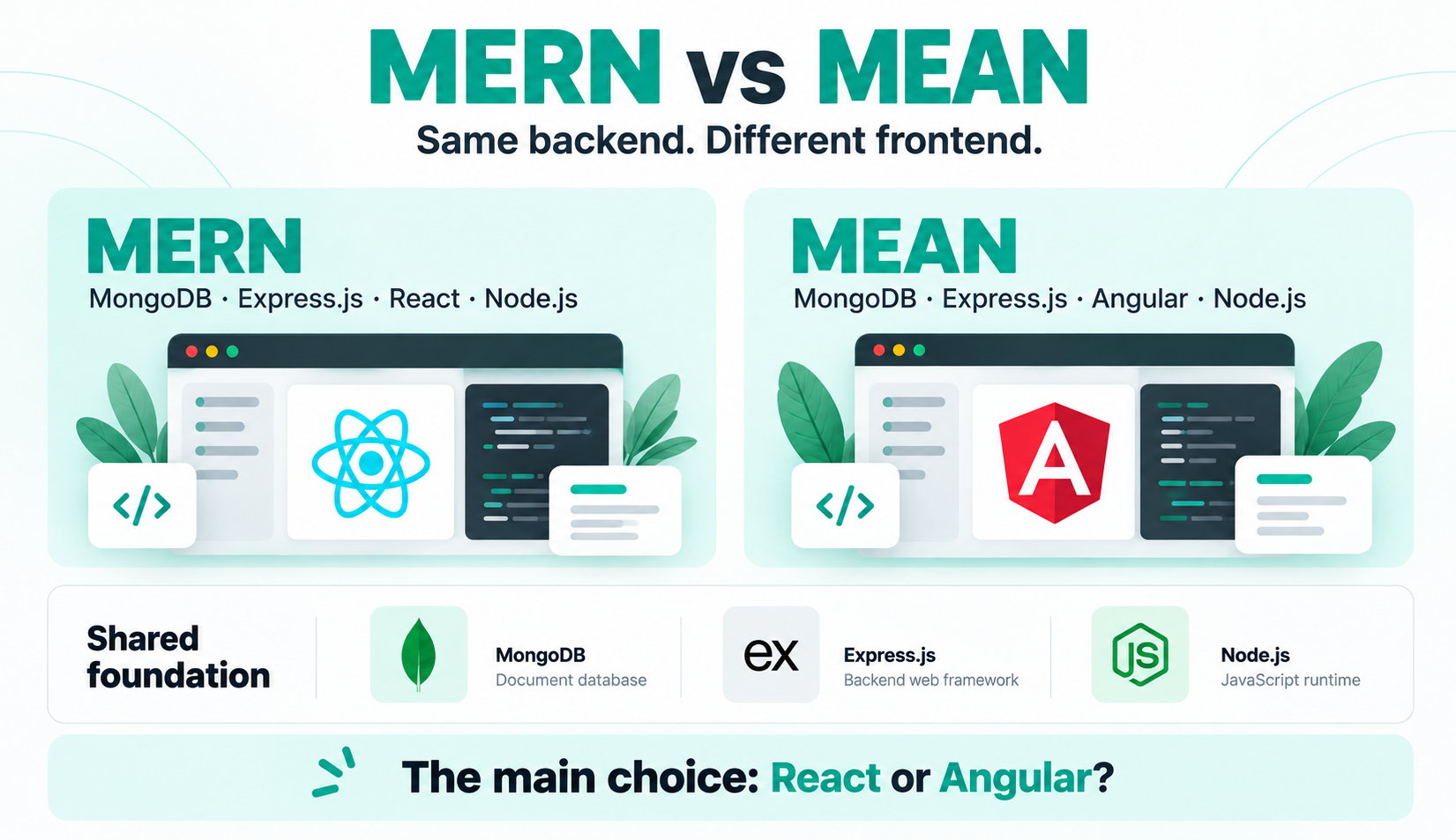
The right tech stack should support both the application's features and the changes it needs as the product grows. Today, two tech stacks are gaining popularity: the MERN and MEAN stacks. Both are strong choices for building an app and share common elements, such as MongoDB, Node.js, and Express.js. The main difference comes in their frontend. In this article, we explain both stacks and compare MERN vs. MEAN in depth across different factors.
What is Full Stack Development
Full stack development means building a responsive website that works well on both the frontend and backend. A full-stack developer has the skills to work comfortably across both.
A tech stack is the combination of tools a developer chooses to do their work. The MERN stack and MEAN stack are both popular, and both let you write the app in TypeScript and JavaScript.
What is the MEAN Stack?
The term MEAN stack refers to a combination of 4 technologies: MongoDB, Express.js, Angular, and Node.js. All 4 technologies work together to simplify the web development process. Because JavaScript can be used for both the frontend and backend, developers can build an application using a single programming language.
1. MongoDB
MongoDB, a NoSQL database, is highly scalable and stores data flexibly in JSON-like documents. Due to its unique adaptability feature, this approach is suitable for applications that have vast and unstructured databases.
2. Express.js
It acts as a top layer of Node.js and is a lightweight backend framework. It simplifies backend development by providing tools for API development, routing, and responses. With Express.js, users can build APIs that help the frontend communicate directly with the server and access a large amount of data from the database.
3. Angular
A powerful frontend framework that creates responsive user interfaces and enhances functionality. It is useful for building single-page web and mobile applications. It quickly processes constantly changing data.
4. Node.js
Node.js is what lets JavaScript run on the server, not just in the browser. It’s built on Chrome’s V8 engine, so it’s fast, and it uses an event-driven, non-blocking model.
That’s why Node.js handles thousands of requests at once. In a MEAN stack app, it’s the engine behind the server: it receives HTTP requests, talks to MongoDB, and sends the response back to the Angular frontend. One language, front to back, with no switching between JavaScript and something like PHP or Java.
Pros and Cons of Hiring a MEAN Stack Developer
The MEAN stack offers several advantages, including cost-effectiveness, scalability, and open source across the entire process. It also allows the consistent use of JavaScript throughout the entire stack. However, it still has a few drawbacks. Let's discuss in detail.
Pros
Some of the key benefits include:
· Reduce the need for developers to juggle various languages.
· Offer a unified system for faster development.
· Deliver highly personalized application visuals and functionality because of its Angular modular architecture.
· All technologies in the MEAN stack use JSON data; thus, all the data is present in a consistent form.
· It has isomorphic code capability, meaning developers can write the code once and run it simultaneously.
· It has all the essential tools required for building complex and interactive applications.
· It can easily integrate into cloud-based applications.
Cons
Here are the disadvantages of using the MEAN stack:
· Data security is the main concern when using MEAN; for example, MongoDB has been criticized for security vulnerabilities.
· Express and MongoDB both work on the server side, which means they require a stable internet connection to work.
· There is a learning curve, which means it is difficult for beginners to learn all four frameworks.
· Although Node.js is known for its speed and performance, it doesn't work well when there is a requirement for high CPU-intensive processing.
· Limits SEO friendliness because SPAs take time to load the content, which is less favorable for SEO.
What is MERN Stack?
It is a popular full-stack Java framework that provides an efficient platform for building scalable, highly responsive web and mobile applications. It shares similarities with the MEAN stack, but it stands out by using React.
The process is similar to MEAN, except React steals the show by providing fast, interactive, component-based design. This makes the MERN stack an excellent choice for building applications for different e-commerce platforms, dashboards, and other dynamic pages.
Pros and Cons of Hiring a MERN Stack Developer
Pros
There are many reasons why the MERN stack is the preferred choice for most developers. Here are some standout benefits:
· React, which is the core component of MERN, has third party libraries that make it a powerful framework to build complex applications.
· Supports server-side rendering and can index the content fast and effectively.
· Give access to developers to share the code and speed up the loading time.
· It is built on a single language, which is JavaScript. Developers can easily switch between backend and frontend.
Cons
Undoubtedly MERN stack offers many advantages but it is also important to see its drawbacks to make a better decision:
· The dichotomy nature of MERN can be one of the disadvantages, particularly for the clients and developers who prefer uniformity.
· It faces challenges in handling high loads or heavy computations; it is better to build dynamic single-page websites.
· Security is one of the major concerns; for this reason, you must take appropriate security measures.
MERN Stack vs. MEAN Stack: Key Differences
Both are powerful options to build dynamic and advanced websites. They share 3 common technologies: MongoDB, Express.js, and Node.js, but differ in the frontend stack. MEAN uses Angular, while MERN uses React.
Understanding the differences between the MERN vs MEAN will help you select the right option for your business needs.
ü Frontend Framework
MERN uses React, which is a JavaScript library known for building fast and interactive user interfaces. It lets developers reuse code, simplifying the process. MEAN uses the Angular stack that follows the Model-View-Controller (MVC) pattern and comes with built-in features for routing, validation, and application structure.
ü Scalability and Performance
React uses a virtual DOM, which allows it to update the UI efficiently. This offers excellent rendering performance and a smoother user experience. MEAN is a preferable choice for applications that require long-term maintainability.
ü Learning Curve
Another difference when you have to hire MERN stack developer vs MEAN stack developer is the API: Angular has a large and complex API, while React has a simpler one. It provides flexibility through different reusable components. For MERN, it enables faster development and easier feature updates, making it the best choice for owners who want to launch quickly.
ü Popularity
Both have gained popularity among developers. However, because the process is easier and smoother, React garners a little more fame than Angular.
ü Productivity
Developing a more dynamic website with MEAN is easy, as it offers multiple unique features and a prebuilt set of modules. However, MERN requires more setup effort.
ü Project Needs
You have to thoroughly analyze the project's goals, such as integration, security, performance, scalability, and other factors. This way, you can decide which one suits your needs best. MEAN is a more comprehensive, robust tech stack, while MERN is lightweight and more flexible.
ü Security
Angular provides an option for data sanitization, input validation and other security features against XSS attacks and CSRF. While React doesn’t come with any security features.
MEAN Stack vs MERN Stack: Tabular Comparison
MERN vs MEAN Stack for Startups
For most startups, MERN is the safer bet. For large enterprise applications, MEAN tends to age better.
Why startups choose MERN
- Faster MVPs. React's ecosystem has a ready-made library for almost everything, from auth to charts to payments.
- Easier hiring. React is used by roughly 2.5 times as many developers as Angular, so your candidate pool is far bigger.
- Mobile later. If an app is on your roadmap, React Native lets your team reuse its skills and some of its logic.
- AI features. Most AI SDKs and streaming chat examples are written for React first, which saves real build time.
The catch? Freedom cuts both ways. Without a senior developer setting conventions early, a fast-moving React codebase can get messy by month nine. We've seen it more than once.
Why enterprises choose MEAN
- Consistency at scale. When 40 developers touch one codebase, Angular's enforced structure keeps everyone writing code the same way.
- Fewer dependency decisions. Routing, forms, HTTP and testing come from one team, so there's less third-party churn to manage.
- TypeScript everywhere. Strong typing catches bugs before production, which matters a lot in finance, healthcare, and government software.
"MEAN for big, MERN for small" is a starting point. But it's not a universal rule, as many companies rely heavily on React for scalability.

Which Stack Costs Less to Build and Maintain?
The cheaper stack is the one that reduces your actual development and operating effort. There is no universal cost winner. Frontend choices affect implementation, but both stacks also require backend work, infrastructure, testing, and maintenance.
Estimate ownership cost using:
Initial development + training + hosting + ongoing maintenance + upgrades + handover.
Here is a hypothetical example. Your current React team estimates 400 hours for a defined feature set. Delivering it with Angular requires another 60 hours of training. At an illustrative blended rate of $40 per hour, training adds $2,400 before any other differences.
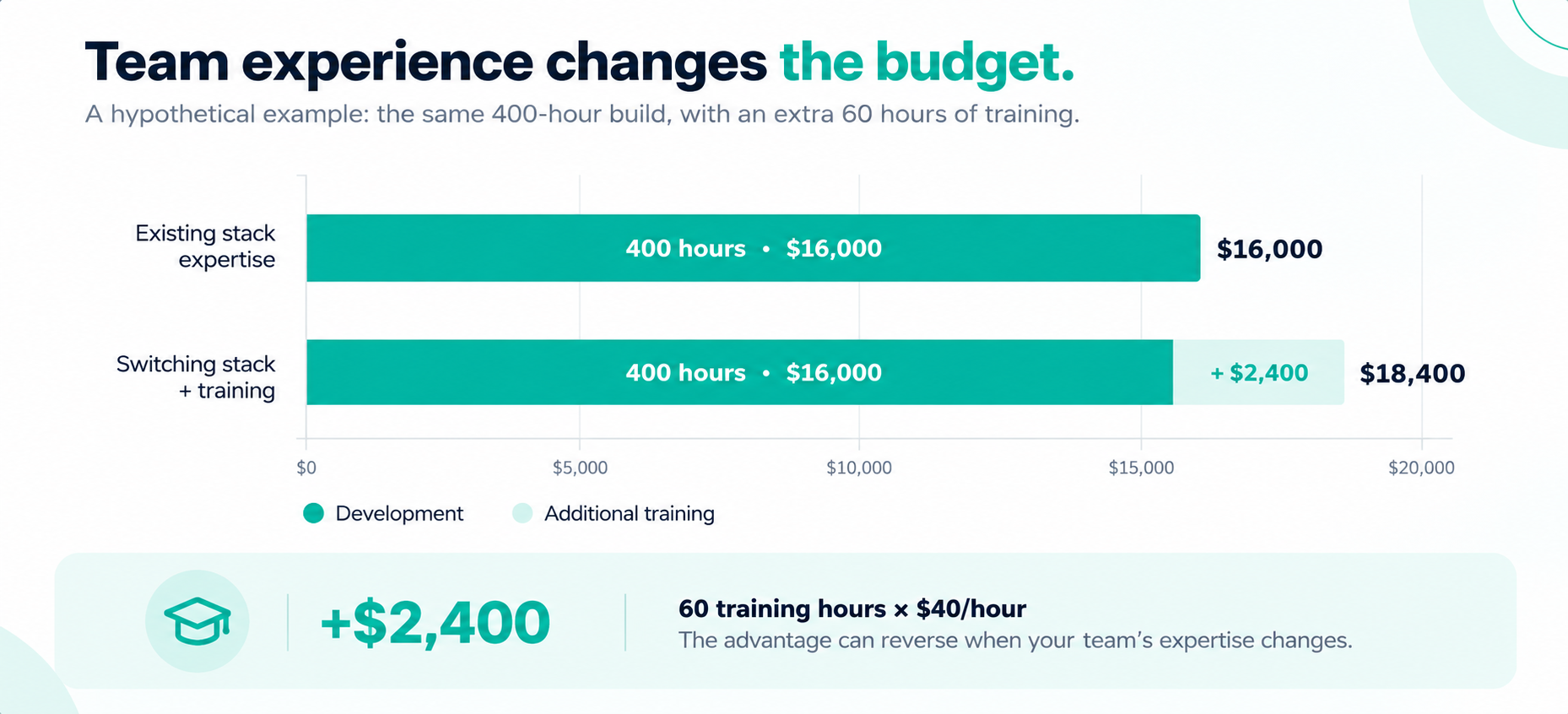
Reverse the team’s experience, and the outcome may reverse too. These figures demonstrate a calculation, not market prices or a claim that React is cheaper.
Is MERN Better Than MEAN for SEO?
Neither stack guarantees better SEO. Rendering configuration matters more than the acronym.
Angular supports server-side rendering, static prerendering, and hybrid rendering. React frameworks also support rendering options suited to different routes.
For example, an ecommerce product page needs content that search engines can access, while a private account dashboard has different requirements. Your architecture can reflect that distinction.
Ask how public pages will deliver content, metadata, correct status codes, and internal links. Also consider caching and server costs.
“MERN is SEO-friendly” is incomplete advice unless someone explains the implementation. An Angular application with appropriate rendering can address the same need.
Why Choose Amrood Labs for MERN and MEAN Stack Development Services
Choosing the right development partner is as important as selecting the right tech stack. At Amrood Labs, our experienced developers will understand your business requirements and recommend the suitable stack for your project. From planning to execution, including testing and deployment, we provide end-to-end customer development services.
Wrap Up
When it comes to MEAN stack vs MERN stack comparison, both provide a reliable solution for full-stack development services. MEAN provides a ready-made framework, making it ideal for larger enterprises and large-scale applications.
While the MERN stack provides better UI development with the help of React, thus making it the preferable choice for dynamic website development. The decision between MEAN vs MERN depends on your project needs, budget, timeframe, and type of application.
FAQs
What does full stack mean?
Full stack means the frontend and backend layers needed to deliver an application, including its data layer. It describes the breadth of development rather than a particular technology combination.
What does full stack developer mean?
A full stack developer works across frontend and backend development, including APIs and databases. Their responsibilities may also include testing and deployment, although expertise varies by role and experience.
What does tech stack mean?
A tech stack is the combination of technologies used to build and run an application. It can include programming languages, frontend tools, backend frameworks, databases, and hosting infrastructure.
What is the difference between MERN and MEAN stack?
MERN uses React for the frontend, while MEAN uses Angular. Both share MongoDB, Express.js, and Node.js. The practical difference concerns frontend tooling, conventions, and how teams organize development.
Which is better, MERN or MEAN stack?
The better choice depends on your team, product requirements, and maintenance plan. MERN suits teams comfortable with React and their chosen ecosystem. MEAN suits teams that benefit from Angular’s integrated framework.
Which stack is better for large enterprise applications?
Either stack can support large enterprise applications; MEAN may suit teams seeking consistent framework conventions. MERN also remains an option when teams establish shared architecture, testing practices, and dependency policies.
.png)

Learn why parallel Git branches create duplicate migration numbers and how to fix migration conflicts using GitHub Actions. Includes workflow code, testing strategies, and database migration tools.

Six real JWT vulnerabilities, working exploits, and the fixes that stop them. Includes OWASP guidance and a 2026 JWT security checklist for developers.
