
Why Manufacturing Web Platforms Fail to Integrate with Legacy Systems
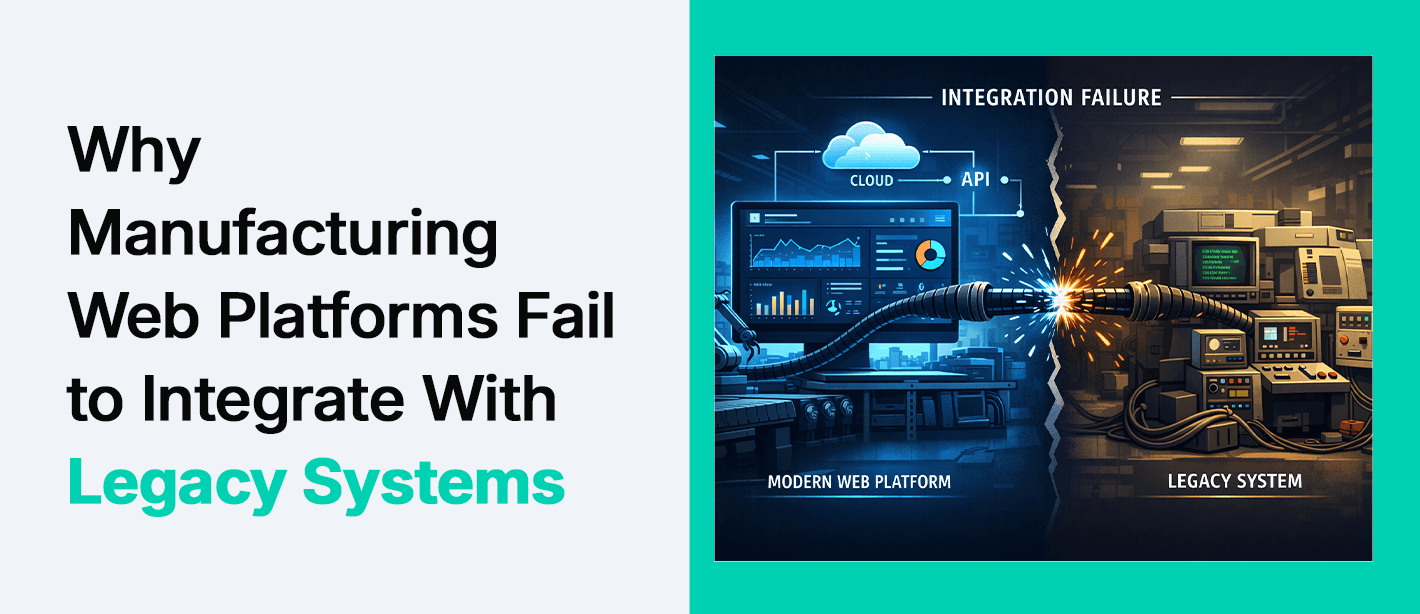

Manufacturers have invested decades and millions into ERP, MES, PLM, and homegrown systems that keep production moving. These systems don’t work elegantly and are deeply concerned about how order flow, how revenue is generated, and how plants run. When a new web platform is introduced, whether it's a customer portal, distributor hub, or digital commerce layer, it’s often expected to “just connect” to what already exists.
That expectation is where most failures begin.
Integration issues won't really cause the dramatic breakdown on the first day; instead, they appear quietly. You may find the platform advanced, but the reality is totally different. Customers lose trust. Internal users lose interest, and investors start to question the worth of their investment.
The reason for the failure is not due to malicious intent or a technical issue, but rather a structural mismatch between how the legacy system is designed and how it is intended to function. Understanding that gap and addressing it deliberately is the difference between a platform that scales and one that stalls.
Understanding Legacy System Integration
Legacy systems refer to long-standing software and infrastructure that continue to support critical business operations. In manufacturing, these systems often include ERP platforms, MES tools, PLM environments, inventory systems, quality management software, and custom-built applications that have evolved over decades.
Legacy system integration is the process of enabling these systems to exchange data and workflows with modern platforms, such as cloud-based web applications, analytics tools, and customer-facing portals, without fully replacing the original systems.
In theory, integration sounds straightforward. In practice, it is complex because legacy systems:
- Were not designed with APIs or real-time access in mind
- Often rely on batch processing and rigid data structures
- Contain embedded business logic that is poorly documented
- Differ significantly across plants, regions, and acquisitions
For manufacturing web platforms, integration is not just about pulling data. It is about ensuring that pricing, inventory, lead times, order status, and service information remain accurate, consistent, and trustworthy across every digital touchpoint. When the foundation is weak, the entire system suffers no matter how good the interface is.
Legacy Systems Weren’t Built for Integration
Legacy manufacturing systems were developed long before cloud, APIs, and real-time data exchange became the norm. These tools were designed for internal use, often with proprietary architecture, making them rigid and resistant to external connections.
Common blockers include:
- Lack of modern APIs or middleware support
- Inflexible data structures that require custom transformation
- Hardcoded workflows that don’t accommodate external inputs
Trying to plug in a modern web platform to one of these systems is like trying to connect Bluetooth headphones to a cassette player; it just doesn’t work out of the box.
Siloed Data Slows Down Everything
Disconnected systems lead to fragmented information. Your website logs customer requests; the ERP tracks orders; shipping details live in another system. The result? No unified source of truth.
This fragmentation leads to:
- Manual data entry across systems
- Delays in quote generation, order updates, and reporting
In an industry where margins are tight and speed matters, silos are more than an inconvenience they’re a competitive liability.
IT Teams Are Overextended
Manufacturing companies sometimes have limited resources for their own IT departments. There isn't much time left for creativity between monitoring cybersecurity, addressing daily tickets, and sustaining outdated systems.
Without capacity or expertise, IT teams are forced to:
- Use temporary workarounds like spreadsheets and exports
- Delay integration projects due to complexity
- Avoid changes that might disrupt aging systems
This backlog creates a vicious cycle: the longer integration is postponed, the more fragile the system becomes, and the harder it is to fix later.
Poor Documentation Creates Risk
Many legacy systems lack proper documentation. Over the years, original developers have moved on, updates have been made informally, and processes are embedded in tribal knowledge.
This makes integration risky:
- No clear data mapping for integration
- Unknown dependencies between modules
- Surprise behavior when changes are made
Without reliable documentation, even small integrations become major undertakings, especially when downtime isn’t an option.
Security Concerns Limit Access
The legacy systems are not designed to meet the security concerns. The reality is that integrating them with a public website or any cloud can cause service issues.
Typical vulnerabilities include:
- Outdated encryption or no encryption at all
- Unsupported authentication methods
- Inability to comply with modern regulations like GDPR or CMMC
This forces IT leaders to make a trade-off: secure the system by keeping it isolated, or risk exposure by opening it up to integration.
Design Agencies Overlook Backend Complexity
A beautifully designed website that doesn’t connect to backend systems is a missed opportunity. Unfortunately, many agencies that specialize in manufacturing website development focus primarily on front-end UX and branding without understanding the operational nuances of ERP, MES, or legacy inventory systems.
Without backend fluency, critical features like:
- Live inventory lookups
- Automated RFQ processing
- Customer order tracking
When choosing a manufacturing website design agency, it’s essential to find one that also understands your infrastructure, not just your brand voice.
“Phase Two” Integration Never Happens
Integration is often labeled as "Phase Two" in digital projects. First comes the website launch; integration is pushed to a later date. But in manufacturing, where time equals money, this delay causes real problems.
- Staff avoids using the platform without data syncs
- Manual workarounds become permanent
- Confidence in the new system erodes
What was supposed to be a powerful tool becomes shelfware or worse, a source of daily frustration.
Custom Systems Require Custom Solutions
Off-the-shelf solutions rarely work in manufacturing. Whether it’s a homegrown ERP or custom production scheduling software, most legacy systems have been tailored over decades to fit very specific needs.
As a result:
- No universal integration method exists
- Middleware often needs to be custom-developed
- Interfaces must be mapped manually across systems
Website design must go beyond just look and feel. It needs to accommodate the deep operational complexity unique to the sector.
How Legacy Systems Affect Businesses
Legacy systems do more than complicate integration. Over time, they create structural constraints that affect productivity, cost efficiency, data quality, and competitiveness. These impacts are often tolerated because they accumulate slowly, but their long-term effects are significant.
1. Reduced productivity
Legacy systems often struggle to meet the expectations of contemporary operations. Even if they might still work, they frequently need manual workarounds, frequent data entry, and ongoing troubleshooting.
System outages in production settings have immediate repercussions. Order processing stops, and production planning slows down. Departmental communication breaks down. Missed shipments, delayed invoices, and strained customer relations can result from even brief disruptions.
Outdated interfaces and inflexible workflows also hamper employee productivity. Legacy systems cause friction that takes time and attention away from higher-value tasks rather than facilitating focus.
Productivity decreases over time, not because workers are less competent, but rather because the tools they need to do their jobs no longer support the way labor is performed.
2. Waste of money
Maintaining legacy platforms always incurs high costs. Beyond licensing and infrastructure costs, organizations must dedicate significant internal resources to supporting the operational status of outdated systems.
The development team invests a significant amount of time in maintenance and troubleshooting rather than introducing new products to the market. Specialized expertise becomes more complicated to find and more expensive to retain. Hardware dependencies persist long after vendors cease to support them.
In terms of manufacturing, where the time has major importance and directly affects the revenue, even the outdated can result in significant financial loss. These costs rarely appear as a single line item, but they accumulate steadily due to inefficiency, rework, and lost opportunities.
What looks like cost avoidance often becomes a long-term financial drag.
3. Poor data management
Legacy systems were not built for modern data requirements. They struggle to support real-time visibility, advanced analytics, or consistent data governance.
Manufacturers frequently encounter:
- Data silos across departments and plants
- Inconsistent definitions for products, customers, and inventory
- Delayed reporting due to batch processing
- Limited compatibility with analytics and AI tools
When data cannot flow freely and reliably, decision-making suffers. Leaders operate with partial visibility. Teams react instead of anticipate. Opportunities for optimization remain hidden.
Modern manufacturing depends on timely, accurate data. Legacy systems make that increasingly difficult to achieve.
4. Lost competitive advantage
The cumulative effect of reduced productivity, high costs, and poor data management is a gradual loss of competitiveness. Legacy systems limit agility. They make it challenging to respond to market changes, offer customized pricing, or conduct new experiments with businesses. Competitors with more flexible platforms move faster, serve customers better, and adapt with less friction.
This loss of agility can be crucial in manufacturing, where margins are narrow and differentiation is essential. Businesses that are unable to update their digital infrastructure run the risk of slipping behind, not because they lack knowledge, but rather because their processes impede advancement.
The Real Cost of Outdated Software
The longer legacy systems remain untouched, the more they drag down the business. Here's what manufacturers risk when they continue relying on outdated tools:
1. Incompatibility with modern tech
Cloud, AI, and real-time analytics can’t work with closed systems that resist integration.
2. Slower time-to-market
Launching new products or updating services takes longer due to rigid workflows and manual processes.
3. Subpar customer experiences
In the current era, consumers have different expectations. They want the latest updates and personalized interactions, this is something legacy is not able to deliver.
4. Security risks
Obsolete protocols open the door to cyberattacks, with massive consequences.
5. Compliance headaches
New regulations around data privacy, traceability, and emissions can’t be met with outdated tools.
6. Rising operational costs
Manual workarounds and maintenance expenses pile up over time.
7. Opportunity loss
Perhaps most importantly, clinging to legacy systems means missing out on efficiency, automation, and competitive advantage.
A 2026 ERP report found that 72.6% of manufacturers have already adopted AI-driven tools. Falling behind now isn’t just risky it may be irreversible.
How to Minimize Disruption When Upgrading Legacy Systems
One of the biggest fears manufacturers face when considering upgrades is downtime. What happens if operations are disrupted? What if the new system doesn’t work?
These are valid concerns but manageable with the right approach:
1. Take a phased approach
Integrate modern solutions with your existing systems incrementally. Start with non-critical functions to test compatibility and minimize risk before replacing core systems.
2. Secure executive buy-in
Don’t frame the project as an IT initiative; frame it as a business risk. Highlight how integration delays impact revenue, compliance, and customer satisfaction.
3. Bring in external experts
If your internal team lacks the necessary capacity or expertise, consider partnering with consultants who specialize in manufacturing system integration. They can bridge the technical and operational gaps efficiently.
With proper planning, modernization doesn’t have to feel like a high-stakes gamble. It becomes a strategic move that drives long-term resilience and growth.
Final Thoughts
A modern website is no longer just a marketing asset it’s a digital nerve center that should connect every part of your manufacturing business. But without backend integration, even the most polished platform will fall short.
The good news is that solutions exist. Whether through phased integration, API middleware, or custom web development, manufacturers can modernize without disruption. However, it begins by acknowledging that manufacturing website design isn’t just about what customers see. It’s about what your systems can do behind the scenes.
At Amrood Labs, we’ve helped manufacturing firms bridge the gap between modern platforms and legacy systems without halting operations or draining budgets. Because in a connected industry, the true value of your website lies in its ability to connect.
Table of Content
Share Now
.png)



Learn why parallel Git branches create duplicate migration numbers and how to fix migration conflicts using GitHub Actions. Includes workflow code, testing strategies, and database migration tools.
Six real JWT vulnerabilities, working exploits, and the fixes that stop them. Includes OWASP guidance and a 2026 JWT security checklist for developers.

Learn how to hire Sharetribe developers for on-demand marketplaces. Understand Sharetribe Go vs. Flex, required skills, cost factors, vetting questions, and common mistakes to avoid.

