
Hire Node.js Developer: Top Platforms & Hiring Tips for 2026

Companies that want to hire a Node.js developer in 2026 face a crowded, noisy market. There are dozens of platforms, rates that swing wildly from one listing to the next, and no shortage of agencies happy to tell you they've got "senior" talent on standby. Whether you're trying to hire remote Node.js developers for a single API build or looking to hire dedicated Node.js developers for a long-term product team, the hardest part is finding the right candidates among the many.
Here's what we've found actually matters: where to look, which skills are worth testing for, what things cost right now, and the mistakes that tend to bite people after the contract's already signed.
Why Node.js Hiring Is Different from General Developer Hiring
Node.js isn't just "another backend language" it's built around an event-driven, non-blocking architecture that powers real-time apps, microservices, and high-throughput APIs.
A developer who's strong in Node.js needs different instincts than a generalist backend engineer, which is exactly why generic vetting processes often miss when teams try to hire backend developers for Node-specific work.
This matters for hiring because the usual signals, years of experience, a long resume, and familiarity with "JavaScript" broadly, don't reliably predict whether someone can debug a memory leak in a production event loop or design an API that holds up under real concurrent load.
What Node.js Developers Actually Cost in 2026
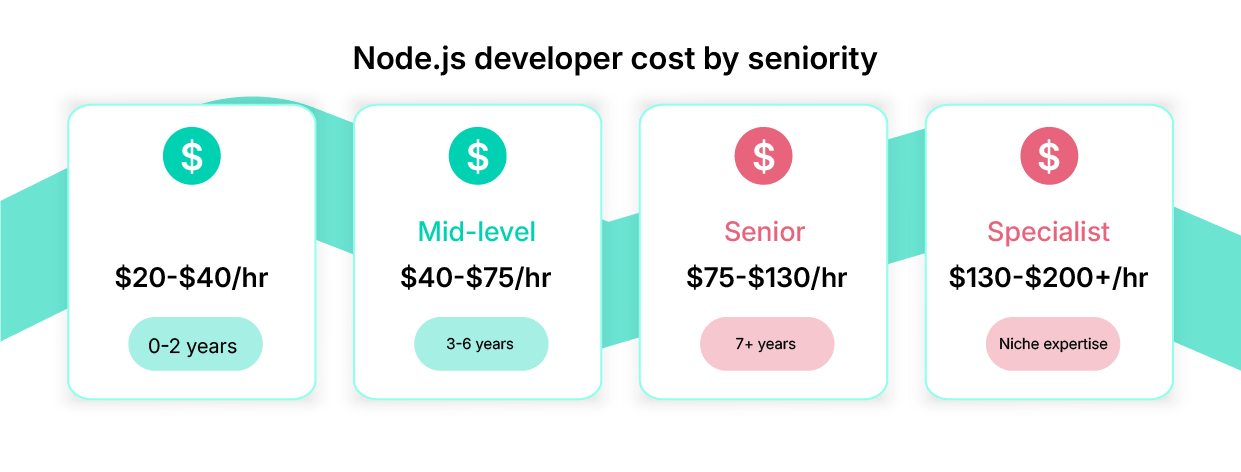
Node.js developer costs vary based on seniority, how you're engaging them, and where they're based, and knowing this before you start conversations saves you from unexpected costs throughout the project.
- Junior (0-2 yrs): $20-$40/hour supervised feature work, bug fixes
- Mid-level (3-6 yrs): $40-$75/hour owns modules, comfortable with Express/NestJS and database integration
- Senior (7+ yrs): $75-$130/hour architecture decisions, performance tuning, mentoring
- Specialist/Architect: $130-$200+/hour distributed systems, high-scale API design
By engagement model, freelance hourly contracts suit best for short-term projects, while managed remote contracts that include monthly or quarterly payments often start around £2,000/month tend to work best when your goal is a full-time job.
An Employer of Record (EOR) sits in between: you get something close to full-time commitment without taking on the legal weight of hiring internationally yourself.
Rates by region also shift meaningfully: North American and Western European developers sit at the top of the rate scale, while Eastern Europe, Latin America, and South and Southeast Asia can save you 30–65%, with the caveat that timezone overlap varies a lot depending on exactly where you're looking.
None of these numbers are fixed; they're a starting point for budget conversations, not a quote. If you're still deciding between stacks, our piece on what to consider before hiring Python developers walks through similar budget tradeoffs from a different angle.
Skills That Matter When You Hire Backend Developers for Node.js
Generic coding tests miss the skills that determine whether a Node.js hire will actually perform well on your codebase.
Core technical fundamentals:
- Event loop behavior and async/await patterns (not just knowing the syntax, but understanding blocking vs non-blocking operations)
- Error handling strategy across async code and middleware
- Memory management and performance debugging under load
Framework and stack fluency:
- Express for lightweight, flexible APIs
- NestJS for structured, enterprise-scale applications with built-in architecture patterns
- Fastify when raw throughput is the priority
Database and API design:
- Comfort with MongoDB (document-based) and PostgreSQL/MySQL (relational), plus ORMs such as Prisma or TypeORM
- REST vs GraphQL tradeoffs, API versioning, and authentication (JWT, OAuth)
Delivery habits:
- Automated testing coverage
- CI/CD pipeline familiarity
- Comfort working in a monitored, code-reviewed environment rather than isolated freelance work
If a candidate can't speak concretely to at least most of these, they're likely a generalist JavaScript developer rather than a Node.js specialist, which matters more the larger and longer-lived your project is. If your project needs a matched frontend too, consider whether you actually need to hire a MERN stack developer instead, since full-stack JavaScript fluency often overlaps with strong Node.js backend skills.
Where to Find Remote Node.js Developers
Different platforms solve different hiring problems, and picking the wrong one for your situation is one of the most common reasons hires don't work out.
Vetted talent networks (Toptal and similar) filter heavily often to the top 3% of applicants through technical and live-coding screening. This is a good fit when you need a senior backend architect fast and are willing to pay a premium for reduced hiring risk.
Open marketplaces (Upwork and similar) give you the biggest pool and the most flexibility on price, with reviews and ratings you can actually check. Good fit if you need a senior backend architect fast and don't mind paying a premium to reduce your own risk.
JavaScript/Node-specialized networks (Arc.dev and similar) sit in between, curated specifically for JS/Node roles, with more targeted matching than a general marketplace but less rigid than an elite vetted network. The vetting principles here mirror what we cover in how to hire React.js developers, since JS-specialized platforms tend to serve both roles.
Direct-hire and no-commission routes (independent outreach, or platforms like Jobbers.io) skip platform fees entirely. The tradeoff is real, though you lose the built-in vetting layer, which means your own screening process has to carry more weight.
Managed staffing/outsourcing partners (agencies like InvoZone, RemoteCrew, or dedicated development partners) handle sourcing, contracts, and sometimes HR/compliance for you, which is useful if you want a dedicated backend developer or team without building an internal hiring pipeline.
.png)
How to Vet a Node.js Developer Remotely
How do you test a Node.js developer's skills without an in-person interview?
So how do you test a developer's skills without meeting them in person? Give them something scoped and practical instead of building an authenticated REST endpoint, for example, and pair it with a live technical interview where they walk you through decisions from their own past work. That combination catches the gaps a resume or a LeetCode score never will.
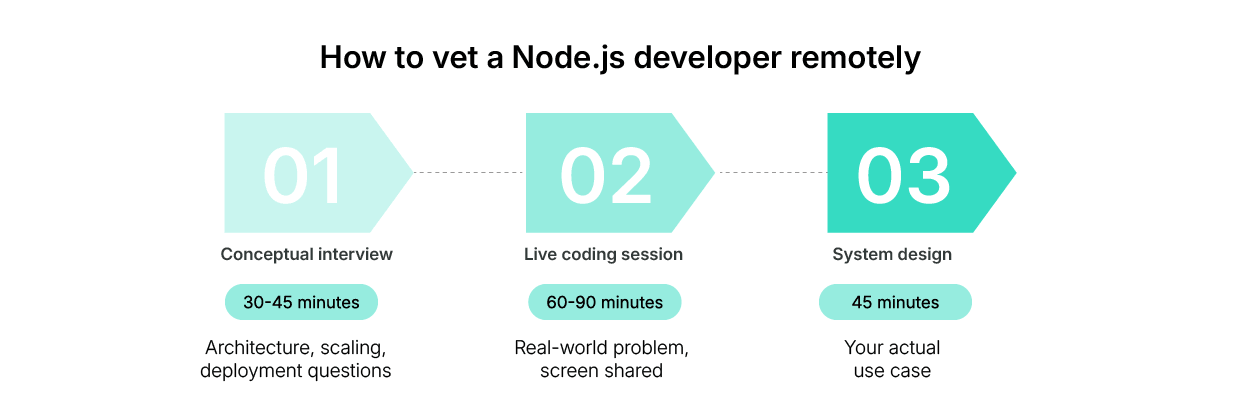
A strong three-stage process looks like this:
1. Conceptual interview (30-45 min): Ask about scalability approaches, database optimization, and deployment workflow
2. Live coding or debugging session (60-90 min): Have them work through something close to your real use case, sharing their screen
3. System design walkthrough (45 min): Ask them to design a solution for a real problem you're actually facing
Reviewing GitHub activity helps too but distinguish between tutorial-clone repositories and projects with real tests, error handling, and iterative commit history. The former tells you very little; the latter tells you a lot. If your Node.js role also touches AI integration work, the vetting approach in how to hire the best remote AI developers is a useful companion read.
The Paid Trial Project: Your Best Risk Filter
A short paid trial remains the single most reliable way to de-risk a Node.js hire, because it shows you real working behavior instead of interview performance.
Run a 1-2 week (or up to 30-day) trial on real project work, not a throwaway task, and evaluate:
- Code quality and adherence to standards
- Communication frequency and clarity in async settings
- Autonomy: how they handle ambiguity without hand-holding
- Whether what they actually deliver matches what they promised in the interview
If your trial project also involves CI/CD or deployment pipeline work, it's worth clarifying upfront whether that falls under this hire or whether you should separately hire a DevOps developer for infrastructure-specific tasks.
Red Flags Specific to Node.js Hiring
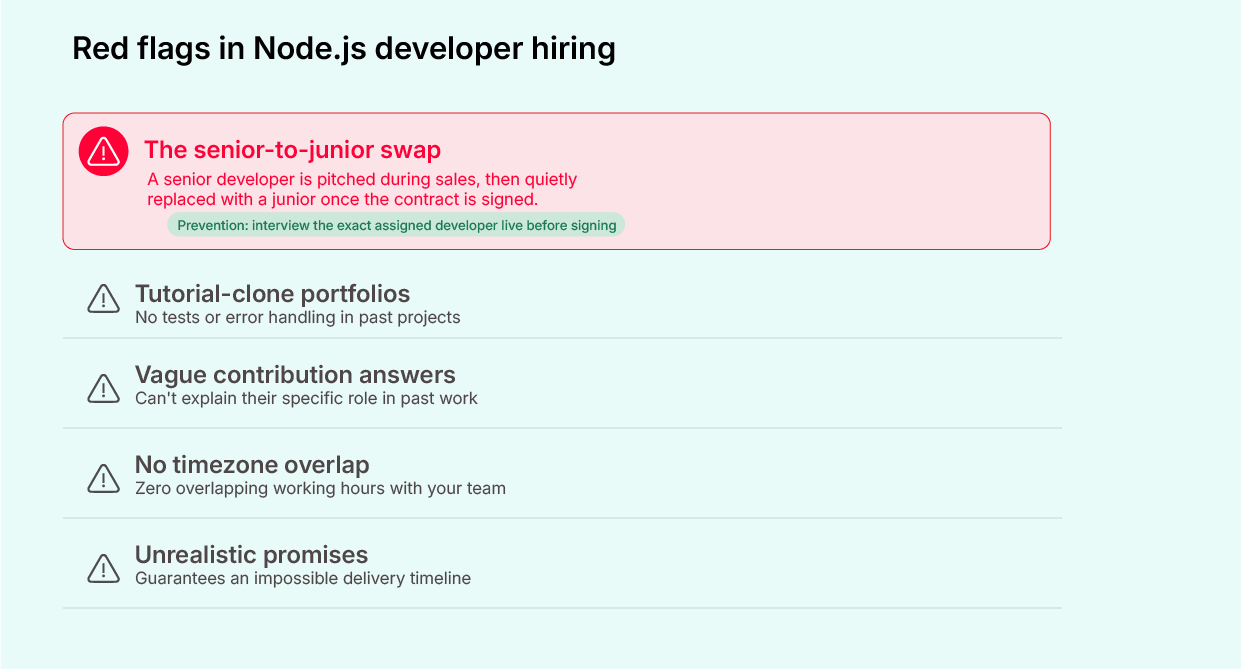
Watch for the "senior-to-junior swap" where an agency or platform pitches a senior developer during the sales process, then quietly assigns a junior developer once the contract is signed. The fix is simple: insist on a live technical interview with the exact person who'll be doing the work, not a sales person or account manager standing in for them.
Other warning signs:
- Portfolios full of tutorial-clone projects with no tests or error handling
- Vague answers when asked to explain their specific contribution to a past project
- No time-zone overlap with your team at all
- Guarantees of unrealistic delivery timelines
Contract Structures and Compliance Basics
Choosing between freelance, EOR, and staff augmentation affects both cost and risk. Freelance gives you flexibility, but IP assignment and compliance responsibility land on you. EOR arrangements handle local employment law and payroll but cost more. Staff augmentation through an agency splits the difference you get management support without full-time legal complexity.
At a minimum, any contract should cover IP ownership (the work product belongs to you, not the developer), an NDA, and clarity on payment terms and currency. If you're hiring across borders, understand your jurisdiction's rules on contractor misclassification this is general awareness, not legal advice, so consult counsel for anything beyond a simple freelance engagement.
Making the Right Call for Your Team
There's no universal right answer here; it comes down to your budget, your timeline, and how much of the vetting you're willing to do yourself. If you need a senior Node.js architect fast, a vetted network justifies its premium. If you're cost-conscious and comfortable running your own screening, a direct-hire route from Amrood Labs or a specialized network can stretch your budget further. If you want an ongoing team without managing HR, a staffing partner is worth the markup.
Whichever route you choose, the paid trial and a scoped technical interview remain the two highest-leverage steps in the entire process they catch what platforms and resumes can't.
Table of Content
Share Now
.png)



.png)

Learn why parallel Git branches create duplicate migration numbers and how to fix migration conflicts using GitHub Actions. Includes workflow code, testing strategies, and database migration tools.

Six real JWT vulnerabilities, working exploits, and the fixes that stop them. Includes OWASP guidance and a 2026 JWT security checklist for developers.

